
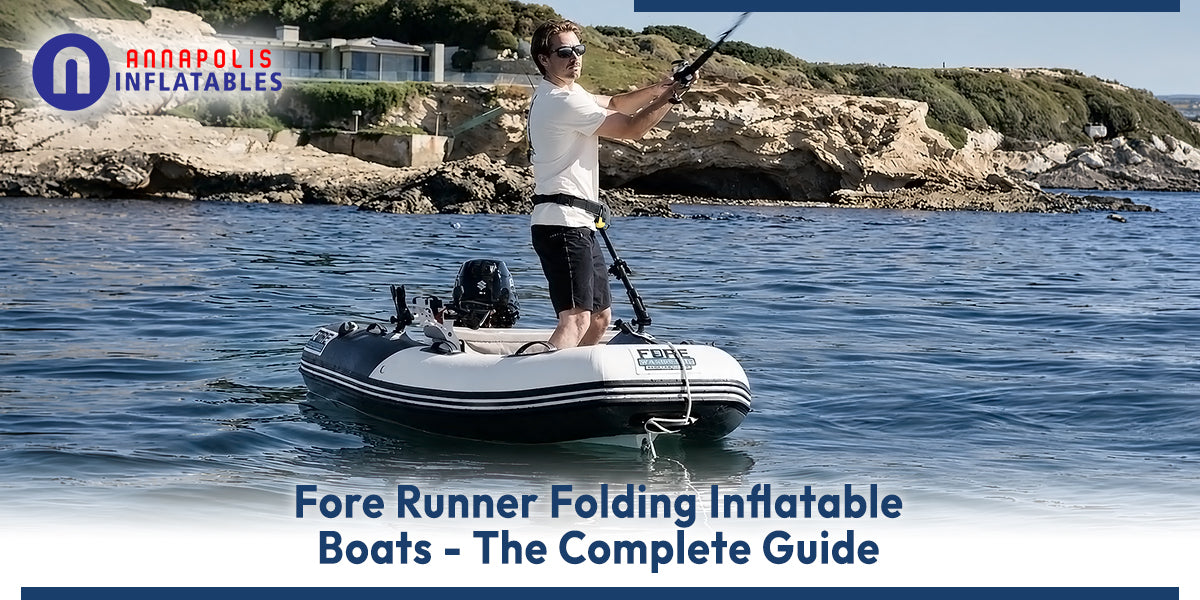
Forerunner Folding Inflatable Boats- The Complete Guide
Table of Contents
- What Makes Fore Runner Folding Inflatable Boats Different
- The ForeRunner Inflatable Boat Range at a Glance
- Build Quality & Performance
- Setup & Maintenance: What to Expect
- Motors, Accessories & Upgrades
- Buying Advice for Fore Runner Foldable Boat in Brief
- Best Fore Runner Boat by Buyer Type
- Final Verdict & Next Step
- FAQs
Most people who want a boat don't buy one. Not because they can't afford it, but because owning one is complicated. You need somewhere to store it, something to tow it, and a ramp to launch it. By the time you've added up the trailer, the storage fees, and the weekend mornings spent rigging and de-rigging, the boat you bought for freedom starts to feel like a second job.
The Fore Runner folding inflatable boat was built to change that calculation entirely. It's a genuine folding inflatable with a fiberglass hull that folds flat, deploys in 4 minutes, and stores in the back of your car. No trailer. No marina fees. No dedicated storage space required.
Currently available in two models, the 290 AS (9'6") and the 340 AS (11'3"), this guide covers everything you need to know about this portable folding boat before buying: what you're getting, which model suits your needs, and where to buy with confidence.
What Makes Fore Runner Folding Inflatable Boats Different

To appreciate what the Fore Runner foldable fishing boat does, it helps to understand the landscape it sits in.
-
Traditional Rigid Boats:
fiberglass hulls, and aluminum tinnies are capable but demand a trailer, a tow vehicle, ramp access, and permanent or paid storage. For many buyers, the logistics make ownership impractical regardless of the price.
-
Standard inflatable boats:
solve the storage problem but introduce a new one: a soft inflatable floor flexes underfoot, limits speed, and gives way in rougher water. They're convenient but compromised.
-
Rigid Inflatable Boats (RIBs):
are the performance answer. A rigid fiberglass or aluminum hull bonded to inflatable tubes. Excellent in chop, fast, and stable. But the rigid hull doesn't fold, which means you're back to trailer-and-storage territory.
The Fore Runner Closes That Gap: RIB Performance Without the Trailer
It has a genuine fiberglass hull with pronounced strakes to grip the water and cut down chop, but the hull folds flat for storage and transport. You get RIB-level performance and capability with the portability of an inflatable. That combination is protected by patent-pending technology in the United States and internationally, and it's what makes the Fore Runner foldable fishing boat genuinely different from anything else on the market.
The ForeRunner Inflatable Boat Range at a Glance

Fore Runner currently offers two models, both built on the same folding fiberglass hull platform:
| Spec | 290 AS (9'6") | 340 AS (11'3") |
|---|---|---|
| Length | 2.9m / 9'6" | 3.4m / 11'3" |
| Beam / Width | 1.6m / 63" | 1.67m / 66" |
| Weight | 43kg / 95 lbs | 48kg / 106 lbs |
| Max Passengers | 4 persons | 4 persons |
| Max Load | 317kg / 700 lbs | 450kg / 992 lbs |
| Max HP | 15hp | 15hp (3hp–15hp recommended) |
| Starting Price | $4,300 | $4,950 |
Both models are closer in size than their names suggest, but the differences between them are meaningful on the water and on the dock.
Size & Deck Space
The 340 AS is half a meter longer and 3 inches wider than the 290 AS. In practical terms, that extra length means more deck space for gear, passengers, and movement, something you'll notice on a full-day fishing trip or when loading dive equipment. The wider beam adds stability, particularly when passengers are moving around or leaning over the side.
Load Capacity
This is where the two models diverge most significantly. The Fore Runner 340 AS is rated to 450kg (992 lbs) against the 290 AS's 317kg (700 lbs), a 133kg difference. That rating covers the combined weight of passengers, motor, fuel, and everything else on board, so understanding where your typical load sits relative to each model's limit is an important part of choosing between them.
Weight & Portability
Despite the size difference, the weight gap is smaller than you might expect, 43kg (95 lbs) for the Fore Runner 290 AS versus 48kg (106 lbs) for the 340 AS. Five kilograms more for a noticeably larger, higher-capacity boat is a trade-off worth understanding before you decide.
Build Quality & Performance of Fore Runner Boats
Most inflatable boats feel like inflatables the moment you step on them, the floor flexes, the hull wallows in chop, and you're constantly aware of its limits. The Forerunner is built differently, and it starts from the ground up.
A Floor That Actually Holds Its Ground
Where a standard inflatable uses a soft or drop-stitch floor, the Forerunner has a rigid fiberglass hull. That means no flex underfoot, proper planing behavior, and the confidence to handle conditions that would leave a soft-floor inflatable struggling. This is the single biggest performance differentiator between a Forerunner and most portable boats in its class.
Hull Design Built for Choppy Water
The hull features pronounced strakes, the ridge lines running along the underside, which help the boat grip the water during turns and cut down the slapping and bouncing that make choppy conditions uncomfortable. This is a design detail found on proper RIBs, not on inflatables, and it shows in how the boat behaves when conditions deteriorate.
Materials That Last
The tubes are constructed from German Heytex fabric with a mold inhibitor and UV inhibitor built into the material itself, not a surface coating that wears off over time. The seams are welded, which significantly increases seam strength and resistance to failure under load. Together, these choices reflect a boat designed for long-term offshore use, not just calm-water convenience.
Capable Across a Range of Uses
Both the 290 AS and 340 AS are rated to 15hp, making them genuinely quick on the water. Forerunner positions them equally for harbor cruising, fishing, diving support, yacht tendering, and rescue service use, a range of applications that speak to how seriously the boat is built.
Setup & Maintenance, What to Expect
Setting Up Your Fore Runner Folding Inflatable Boat
One of the Fore Runner's most practical advantages is how quickly it goes from bag to water. Unlike traditional boats that demand a trailer, a ramp, and a full morning of preparation, the Fore Runner is genuinely ready when you are.
The Fore Runner inflatable boat's hinged fiberglass hull unfolds in three simple steps. Start by unfolding the middle, and finally bring up the front. Once you've done it once, the whole sequence becomes second nature.
Inflation is handled through quick-fill Boston valves in the tubes. Using a 12-volt or battery-operated pump, both the 290 AS and 340 AS inflate in approximately 4 minutes. The boat comes with a carry bag with handles, and when packed, it fits into the following dimensions:
| Model | Packed Size |
|---|---|
| 290 AS | 36" x 36" x 18" |
| 340 AS | 37" x 40" x 18" |
Both models fit comfortably in the back of a standard SUV.
Deflation & Repacking
Packing down is just as quick. Deflation and re-packing is the process of folding 2 times and takes just over 2 minutes. Fold the foremost section back, followed by the middle, and the boat is ready to go back in the carry bag.
Maintenance for Your Fore Runner Inflatable Boat
Maintenance is consistent with any quality inflatable RIB, including Fore Runner foldable fishing boat:
- Rinse with fresh water after every saltwater use, paying attention to the Boston valves and fittings
- Store dry, moisture trapped inside accelerates fabric wear and risks mold, even with the Heytex material's built-in mold inhibitor
- The folding hull works in your favor here because the boat packs down quickly, and you're far more likely to store it indoors rather than leaving it exposed to UV outdoors
- Inspect seams periodically; the 3-year seam and delamination warranty (prorated) covers manufacturing defects
Forerunner Inflatable Boat Warranty Coverage
- Seams and delamination: 3-year prorated warranty
- All accessories (seat, bench, oars, etc.): 2-year warranty
- Contact Fore Runner directly for full warranty terms and claims
Motors, Accessories & Upgrades for Fore Runner Foldable Boats

Both the 290 AS and 340 AS are rated to a maximum of 15hp, giving buyers a wide range of motor options from a small 3hp for quiet harbor use up to a full 15hp outboard for open-water performance.
Both models are also fully compatible with electric trolling motors, making them one of the best foldable fishing boats for use where noise and emissions matter.
Always stay within the rated horsepower for your model. Exceeding the maximum hp rating compromises safety and will affect your warranty coverage.
Available accessories for Fore Runner foldable boat:
| Accessory | Price |
|---|---|
| Portable Pump (BEWELLAERO 25PSI) | $295 |
| Launch Wheels | $240 |
| Seat Cushion & Gear Bag | $220 |
| Solar Navigation Light | $170 |
| Dinghy Anchor Kit | $180 |
| Single Rod Holder / Transom | $70 |
| Rod Holder for Oar Locks | $25 |
| Dual Drink Holder / Transom | $77 |
| Spear Gun Rack | $150 |
The pump is the priority purchase if you don't already own a high-pressure SUP pump. Launch wheels are worth considering if you're regularly launching solo from a beach or ramp. The solar navigation light is essential if you plan any dawn or dusk use.
Buying Advice for Fore Runner Foldable Boat in Brief
At $4,300 for the 290 AS and $4,950 for the 340 AS, the Forerunner sits at a premium price point, but context matters. You're not buying an inflatable dinghy; you're buying a folding RIB with a fiberglass hull built for offshore use. Compared to a comparable rigid RIB plus trailer plus storage costs, the value proposition holds up well.
Budget for the Full Setup
Don't forget to budget $295 for the pump, it's not included, and you'll need it on day one.
Buy Through an Authorised Dealer
Forerunner boats are currently available new only. The authorized dealer is Annapolis Inflatables at Annapolis Inflatables. Buying through an authorized dealer is the only way to ensure your 3-year seam warranty and 2-year accessories warranty are valid. Don't risk that for a marginal price saving elsewhere.
Know What You're Buying
The Forerunner's folding fiberglass hull is patent-pending technology in the United States and internationally. If you come across cheaper boats that look similar, they aren't the same product. The engineering behind how this hull folds and performs is proprietary, and that distinction matters when you're on open water.
Best Fore Runner Boat by Buyer Type
With only two models in the range, the choice is straightforward; it comes down to load capacity and budget:
| Buyer Type | Recommended Model | Reason |
|---|---|---|
| Solo or couple, fishing, diving, harbor use | 290 AS (9'6") | Lighter at 43kg, max load 317kg, easier to handle solo, lower entry price |
| Family groups or heavier loads | 340 AS (11'3") | Higher max load of 450kg / 992 lbs, slightly wider beam for added stability |
| Yacht tender (compact priority) | 290 AS (9'6") | Smaller pack size suits yacht storage; ample capacity for tender duties |
| Open-water or offshore use | 340 AS (11'3") | A greater load rating and size provide more margin in demanding conditions |
| Budget-conscious buyer | 290 AS (9'6") | $650 less than the 340 AS; still rated to 15hp and 4 persons |
If you're regularly carrying four people with gear, or operating in open water where conditions can change, the 340 AS is the better choice. For most single or paired use cases, fishing, diving, and tendering, the 290 AS delivers the full Fore Runner experience at a lower price and lighter weight.
Final Verdict & Next Steps
The Fore Runner is not a compromise product. It's a genuine folding inflatable RIB with a fiberglass hull, German Heytex fabric with welded seams, offshore-capable construction, and patent-pending folding technology, all in a package that deploys in 4 minutes and stores without a trailer. For buyers who need real on-water capability alongside genuine portability, it occupies a space that very few boats can.
At $4,300–$4,950, it sits at a premium price point, but you're buying a boat built to RIB standards, not an inflatable dinghy dressed up with marketing language.
Still weighing your options or unsure which model fits your use case? The team at Annapolis Inflatables knows these boats inside out, from first-time buyers choosing between the 290 AS and 340 AS, to experienced boaters making the switch from a traditional RIB. Contact Annapolis Inflatables experts before you buy. A five-minute conversation could save you from choosing the wrong model or confirm you've already found the right one.
FAQs
Do I need a trailer to own a Fore Runner boat?
No. Both the 290 AS and 340 AS pack into a carry bag that fits in the back of a standard SUV. No trailer, no ramp dependency, no marina storage fees. Unpack it, inflate in 4 minutes, and you're on the water.
Which model should I buy, the 290 AS or the 340 AS?
It comes down to how much you're carrying. Both models seat 4 passengers, but the 340 AS handles up to 450kg (992 lbs) versus the 290 AS's 317kg (700 lbs). If you're regularly out with a full load of people and gear, go with the 340 AS. For solo or paired use, fishing, diving, or tendering, the 290 AS does the job at $650 less.
Is the pump included with the boat?
No. The recommended BEWELLAERO 25PSI Super Fast Pump is sold separately at $295 through Annapolis Inflatables. Factor it into your budget from the start — you'll need it before your first launch.
Can the Fore Runner handle rough or open water?
Yes. Unlike standard inflatables that are built for calm conditions only, the Fore Runner has a rigid fiberglass hull with pronounced strakes, double-welded German Heytex seams, and offshore-capable construction. Fore Runner positions both models for open water, rescue service use, and harbor cruising, not just flat-water recreation