
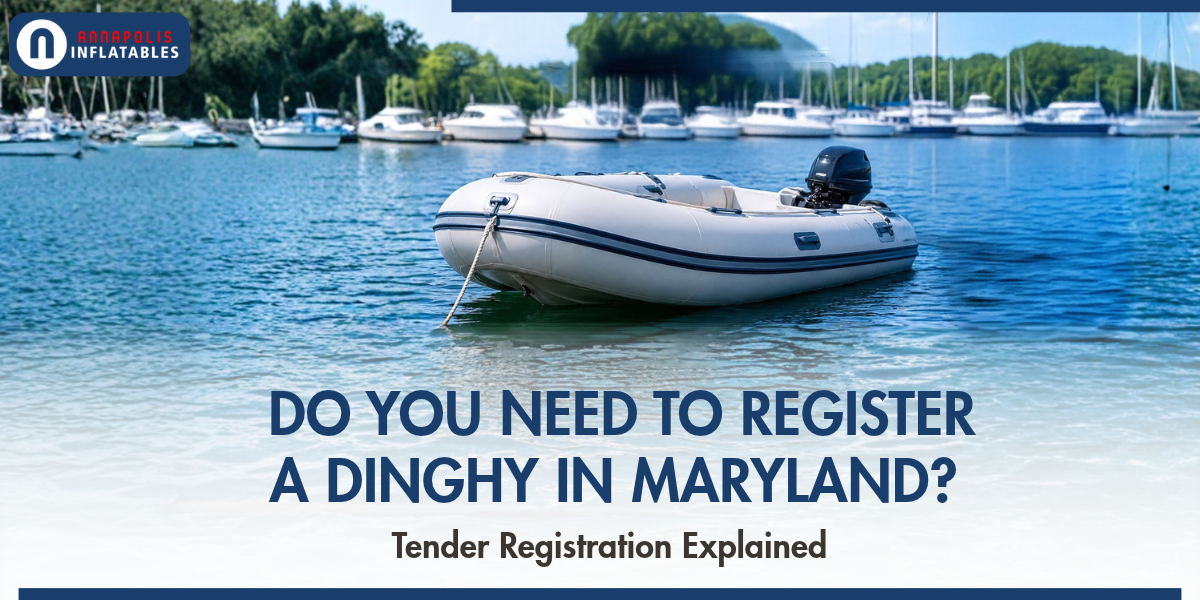
Do You Need to Register a Dinghy in Maryland? Tender Registration Explained
Yes, in most cases. In Maryland, any inflatable dinghy or boat tender with a motor of any kind, gas or electric, must be titled and registered with the Maryland Department of Natural Resources (DNR). A dinghy that is only rowed does not need to be registered. There is also one narrow exception: a tender with less than 10 horsepower, used only to travel between a registered (numbered) boat and the shore, can display the main boat's number with the suffix "1" instead of its own registration.
This guide from Annapolis Inflatables explains exactly when tender to boat registration is required, how Maryland's tender exemption works, what applies to tenders of Coast Guard documented boats, and the safety rules every dinghy owner on Maryland waters should know.
Key Takeaways
- Any dinghy with propulsion machinery of any type, including an electric outboard, must be registered and titled in Maryland.
- Dinghies that are only rowed or sailed are exempt from registration.
- Maryland exempts tenders under 10 HP used only between a numbered vessel and the shore, if the tender displays that vessel's number followed by "1".
- Coast Guard documentation of your main boat does not cover your tender or dinghy.
- Marking a dinghy "T/T" with your boat's name is not a recognized exemption in Maryland.
Table of Contents
- Do Inflatable Boats Need to Be Registered in Maryland?
- What Is Maryland's Tender Exemption?
- What About Tenders to Coast Guard Documented Boats?
- Does Marking "T/T" on a Dinghy Exempt It from Registration?
- Maryland Dinghy Registration Scenarios at a Glance
- How to Register and Title a Dinghy in Maryland
- How to Display Registration Numbers on an Inflatable Dinghy
- Inflatable Dinghy Safety Tips and Maryland Rules
- Where Can You Buy a Highfield Tender in Annapolis?
- Frequently Asked Questions About Registering a Dinghy in Maryland
Do Inflatable Boats Need to Be Registered in Maryland?
Yes, if they have a motor. Maryland law requires any vessel equipped with propulsion machinery of any type to be numbered, and DNR states that a vessel principally operated in Maryland with mechanical propulsion must be registered. Vessels that are not federally documented receive a Maryland boat number and a Maryland vessel title.
So when boaters ask do inflatable boats need to be registered, the answer depends on how the boat is propelled, not on whether it is inflatable. The same rules apply to an inflatable boat dinghy, a rigid dinghy boat, or a full-size powerboat.
- Gas outboard: Registration and titling required.
- Electric outboard or trolling motor: Registration and titling required, because the law covers propulsion machinery of any type.
- Oars or paddles only: No registration required. Maryland exempts manually propelled vessels.
- Sail only: No registration required. Maryland exempts vessels propelled only by sail.
If you add a motor to a dinghy you have been rowing, Maryland's motorized vessel rules apply from that point on, and the dinghy must be registered before you use it with the motor. That includes quiet, lightweight electric outboards, which are a popular choice for small tenders. If you are deciding between the two, our comparison of electric vs gas outboard motors explains the trade-offs for inflatable boats.
What Is Maryland's Tender Exemption?
Maryland's regulations include a narrow exemption for tenders. Under COMAR 08.04.03.03, the numbering requirements do not apply to a vessel equipped with propulsion of less than 10 horsepower that is used exclusively for direct transportation between a numbered vessel and the shore. The tender must display the number of the numbered vessel followed by the suffix "1".
To qualify, your inflatable tender boat must meet every condition:
- Under 10 HP: The outboard must be less than 10 horsepower.
- Ship-to-shore use only: The tender is used only to travel directly between the main boat and the shore. Fishing, exploring, or cruising around the harbor in the tender is not covered.
- Tender to a numbered vessel: The main boat must be a numbered vessel, meaning it carries a state registration number.
- Correct marking: The tender displays the main boat's number followed by the suffix "1".
This mirrors the federal exemption in 33 CFR 173.13, which covers tenders under 10 horsepower used only for direct transportation between a numbered vessel and the shore. If you plan to use your dinghy for anything beyond simple trips to and from your boat, register it separately.

What About Tenders to Coast Guard Documented Boats?
Documentation of your main boat does not cover your tender. The U.S. Coast Guard National Vessel Documentation Center states that documentation of a vessel does not cover the vessel's tender or dinghy.
This creates an important gray area. Maryland's tender exemption applies to tenders of a numbered vessel, and federally documented boats principally operated in Maryland are not numbered by the state. Instead, they display documented use decals. Because of this, owners of documented boats should not assume the tender exemption applies. If your main boat is documented and your dinghy has a motor, confirm your requirements with Maryland DNR. In most cases, the safest approach is to title and register the tender.
Does Marking "T/T" on a Dinghy Exempt It from Registration?
No. Marking "T/T" or "Tender To" with your boat's name is not a recognized exemption in Maryland. It is one of the most common myths among dinghy owners. Some boaters believe that lettering a dinghy "T/T" followed by the main boat's name removes the need for registration, but Maryland's only tender exemption requires the main boat's registration number followed by "1", and only under the conditions listed above.
If your tender does not meet all four conditions of the exemption, it needs its own registration, title, number, and decals.
Maryland Dinghy Registration Scenarios at a Glance
Use this table to answer the question do we have to register a dinghy tender for your situation.
| Your Dinghy | Registration Required in Maryland? |
|---|---|
| Rowed only, no motor | No |
| Sail only, no motor | No |
| Any motor, gas or electric, used for cruising, fishing, or exploring | Yes: title, registration, number, and decals |
| Under 10 HP, used only between your numbered (state-registered) boat and shore | Exempt if it displays your boat's number followed by "1" |
| Tender to a Coast Guard documented boat, with a motor | Documentation does not cover the tender. Confirm with DNR; most owners should register |
| Validly registered in another state and visiting Maryland | Recognized while visiting. Vessel excise tax applies after 90 days in a calendar year |
| Marked "T/T" with your boat's name only | Not a recognized exemption |

How to Register and Title a Dinghy in Maryland
Maryland handles titling and registration together through DNR. Here is how the process works for a new motorized dinghy:
- Complete the application: Fill out DNR Form B-240, Maryland's application for a vessel title and certificate of number.
- Provide proof of ownership: For a new boat, include the original Manufacturer's Certificate of Origin assigned to you by the dealer.
- Pay the excise tax and fees: Maryland charges a 5% vessel excise tax on the total purchase price of the vessel, motor, and accessories, not including the trailer, plus title and registration fees.
- Submit your application: Apply through a DNR Licensing and Registration Service Center. The Annapolis Service Center is located at 160 Harry S Truman Parkway, Annapolis.
- Receive your number and decals: DNR issues your boat number, certificate of number, and validation decals.
A Maryland certificate of number is valid for up to two years and expires on December 31 of the year after it is issued. Keep the registration card on board whenever you use the dinghy, and notify DNR within 15 days if you sell, trade, or transfer it. Fees, service center locations, and hours can change, so confirm current details with DNR before you apply.
How to Display Registration Numbers on an Inflatable Dinghy
Your boat number must be displayed on both sides of the forward half of the dinghy. DNR requires the number to:
- Read from left to right.
- Use plain vertical block characters at least 3 inches high.
- Contrast with the color of the background.
- Be placed as high above the waterline as practical.
- Have letters separated from numbers by hyphens or spaces.
Your validation decals must be displayed near the boat number, as DNR specifies. On an inflatable dinghy, apply lettering to a clean, dry tube surface using numbers made for inflatable boat fabric.
If your Highfield tender wears dinghy chaps, make sure your registration number and decals remain clearly visible and meet DNR display rules. Our guide on how CHAPS extend the life of your Highfield Classic tender explains how tube covers protect your boat between trips.

Inflatable Dinghy Safety Tips and Maryland Rules
Registration is only one part of operating a dinghy legally in Maryland. These inflatable dinghy safety tips and state rules apply to most motorized tenders:
- Carry a boating safety certificate: Anyone born on or after July 1, 1972 must carry a certificate of boating safety education to operate a numbered or documented vessel on Maryland waters.
- Supervise young operators: If someone under 16 operates a motorized vessel less than 11 feet long, they must be supervised by a person of any age who holds a valid boating safety certificate.
- Life jackets for everyone: Every recreational boat must carry one wearable, Coast Guard approved life jacket for each person aboard. Children under 13 must wear a life jacket while underway on a recreational vessel under 21 feet long.
- Use your engine cut-off switch: Federal law requires operators of boats under 26 feet with an engine of about 3 horsepower or more to use an engine cut-off switch when on plane or above displacement speed, if the boat is equipped with one.
- Bring a sound device: Vessels under 39.4 feet must carry a whistle, horn, or other means of making an efficient sound signal.
- Light up at night: Dinghies under power must show navigation lights between sunset and sunrise. A dinghy being rowed must have a flashlight or lantern showing a white light ready to prevent a collision.
- Respect the load limit: Never exceed the manufacturer's maximum persons, load, and horsepower ratings for your inflatable boat dinghy.
For a full checklist of gear to keep aboard, see our guide to inflatable boat safety essentials.

Where Can You Buy a Highfield Tender in Annapolis?
Annapolis Inflatables, a subsidiary of Fawcett Boat Supplies, is an Annapolis-based dealer for Highfield tenders, Zodiac, Achilles, and Walker Bay inflatable boats. Whether you need a compact Highfield dinghy for short ship-to-shore trips or a larger aluminum-hull RIB for daily use, our team can help you match the right boat and outboard to the way you use your tender. Smaller models in the Highfield Roll Up range, such as the Roll Up 200, 230, and 250, are rated for outboards under 10 HP, while the wider Highfield collection includes larger tenders for bigger crews.
We also carry Highfield dinghy accessories such as custom-fit CHAPS tube covers to protect your boat between trips. Visit Annapolis Inflatables at 919 Bay Ridge Road, Annapolis, MD, call (410) 267-8681, or contact us today to find the right tender for your boat. Get the paperwork right once, and every trip ashore is easy.
This guide is for general information only. Maryland boating laws, regulations, and fees can change, so confirm current requirements with the Maryland Department of Natural Resources before registering your dinghy.
Frequently Asked Questions About Registering a Dinghy in Maryland
Do I need to register an inflatable dinghy with an electric motor in Maryland?
Yes. Maryland requires any vessel equipped with propulsion machinery of any type to be numbered, which includes electric outboards and trolling motors. The only exception is the tender exemption for boats under 10 HP used exclusively between a numbered vessel and the shore.
Do we have to register a dinghy tender if it is only used to get to shore?
Not always. If the tender has less than 10 horsepower, is used only for direct trips between a numbered (state-registered) boat and the shore, and displays that boat's number followed by "1", it is exempt from separate numbering. If you use it for any other purpose, it must be registered.
Do I need to register a dinghy with a 2.5 HP outboard?
Yes, unless it qualifies for the tender exemption. A 2.5 HP outboard is propulsion machinery, so the dinghy must be titled and registered if you use it beyond direct trips between your numbered (state-registered) boat and the shore.
Does my Coast Guard documented yacht cover my tender?
No. The U.S. Coast Guard states that documentation does not cover a vessel's tender or dinghy. Because Maryland's tender exemption refers to tenders of numbered vessels, owners of documented boats should confirm their requirements with Maryland DNR.
Do I need a boating license to drive a dinghy in Maryland?
Maryland does not issue a boating license, but anyone born on or after July 1, 1972 must carry a certificate of boating safety education to operate a numbered or documented vessel. The certificate is valid for life.
Can I use my dinghy in Maryland if it is registered in another state?
Yes. Maryland recognizes valid numbers issued under another state's federally approved numbering system. However, if the dinghy stays in Maryland waters for more than 90 days in a calendar year, Maryland's vessel excise tax may apply.
Do I need to register a dinghy I only row?
No. Maryland exempts manually propelled vessels from registration. If you later add any type of motor, the dinghy must be registered.
How long does Maryland dinghy registration last?
A Maryland certificate of number is valid for up to two years and expires on December 31 of the calendar year after it is issued.
What is the Maryland boat registration cost?
The Maryland boat registration cost is $70 for a standard two-year registration. In Maryland, standard two-year boat registration costs $70, plus a 5% vessel excise tax (minimum $5, maximum $16,100) and a $20 title fee. The excise tax and title fee apply when you first title a boat or transfer ownership, while the $70 registration fee is paid every two years. The maximum excise tax is adjusted each year, so confirm current amounts with Maryland DNR before you register.
How do I renew my Maryland boat registration for a dinghy?
Maryland boat registration renewal is required every two years, since registration expires on December 31 of the year after it is issued. You can renew eligible registrations online through Maryland DNR or in person at a DNR Licensing and Registration Service Center. The renewal fee is $70 for two years. Once renewed, apply the new validation decals next to your dinghy's registration number, and keep the updated registration card on board.


 Powered by goodChatBot