
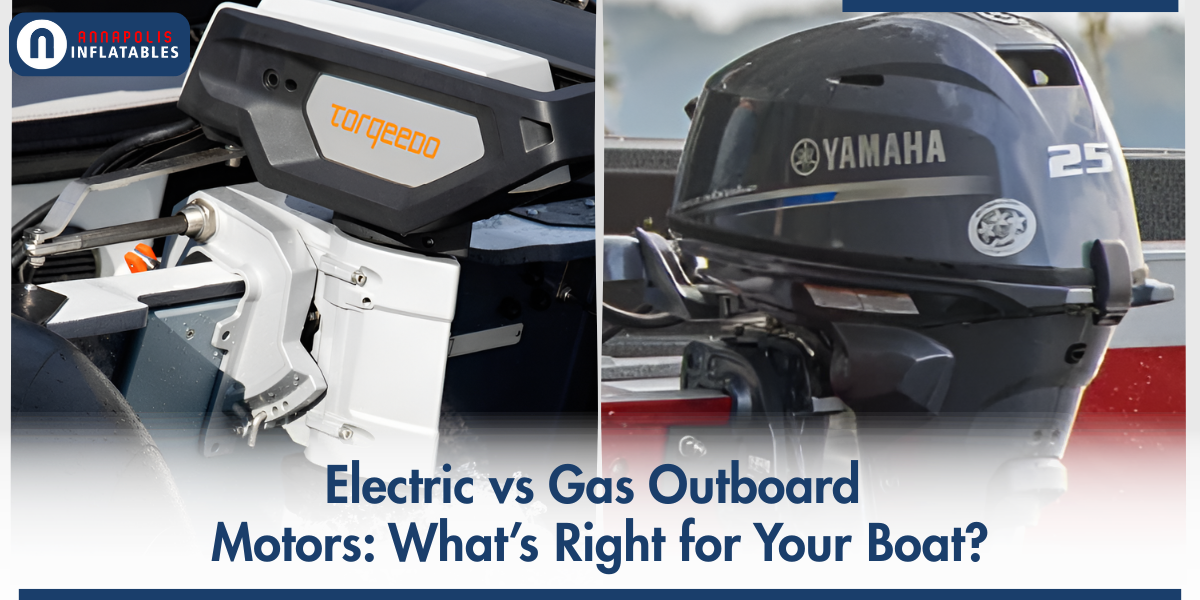
Electric vs Gas Outboard Motors: What’s Right for Your Boat?
Table of Contents
- How Motor Choice Impacts Performance on Inflatable Boats
- Electric vs Gas Outboard Motors for Inflatable Boats: Side-by-Side Comparison
- Understanding Electric Outboard Boat Motors for Inflatables
- Understanding Gas Outboard Motors for Inflatables
- Performance Comparison on Inflatable Boats
- Weight, Balance, and Transom Stress Considerations
- Maintenance and Seasonal Care for Electric vs Gas Outboards
- Environmental and Noise Considerations
- Which Motor Is Right for Your Inflatable Boat?
- Recommended Horsepower Ranges for Common Inflatable Sizes
- Final Decision
- FAQs
Inflatable boats demand a different approach when choosing an outboard motor. Weight, portability, balance, and ease of handling matter just as much as power. This guide compares electric and gas outboard motors through the lens of inflatable boat use, helping owners choose the option that aligns with their boating style, water conditions, and long-term ownership goals.
How Motor Choice Impacts Performance on Inflatable Boats
The type of outboard motor used on an inflatable directly affects how the boat performs on the water. Thrust delivery, cruising range, noise levels, and ongoing upkeep all influence whether an inflatable feels efficient or underpowered in real-world use.
Because inflatables are commonly paired with low to mid-horsepower outboards, the differences between electric and gas motors become more pronounced. Factors such as sustained power output, battery or fuel capacity, and ease of operation play a larger role in determining how suitable a motor is for day-to-day use on an inflatable.
This makes comparing electric and gas outboards less about preference and more about matching performance characteristics to intended use.
Electric vs Gas Outboard Motors for Inflatable Boats
| Factor | Electric Outboard Boat Motors | Gas Outboard Motors |
|---|---|---|
| Power Output | Best suited for low to moderate thrust requirements | Wide horsepower range, suitable for larger and heavier inflatables |
| Acceleration | Instant torque at low speeds | Strong acceleration across a broader speed range |
| Top Speed | Limited, optimized for cruising speeds | Higher top speeds, easier planing |
| Range | Restricted by battery capacity | Extended range with quick refueling |
| Refueling / Recharging | Requires access to power and recharge time | Fast refueling at marinas or portable tanks |
| Weight on Transom | Generally lighter system weight | Heavier engine and fuel load |
| Noise Level | Nearly silent operation | Audible engine noise |
| Maintenance Needs | Minimal, fewer moving parts | Regular servicing required |
| Seasonal Care | Battery storage and charging management | Fuel stabilization and winterization needed |
| Environmental Impact | Zero local emissions | Produces exhaust emissions |
| Operating Cost | Lower long-term running costs | Ongoing fuel and service expenses |
| Best Use Case | Short trips, inland waters, tenders | Coastal use, longer trips, varied conditions |
| Availability & Service | Growing but limited service network | Widely available service and parts |
These differences become clearer when viewed through real-world inflatable use cases, outlined below in Which Motor Is Right for Your Inflatable Boat?
Understanding Electric Outboard Boat Motors for Inflatables
Electric outboard motors operate on battery power, most commonly lithium-ion, and are designed for quiet, simplified operation. On inflatables, their real-world performance is closely tied to how power is used over time.
At lower speeds, electric motors deliver smooth, consistent thrust that suits displacement cruising and controlled maneuvering. However, passenger load, wind resistance, and throttle setting can significantly affect battery consumption on inflatables. Higher speeds and heavier loads draw power more quickly, reducing usable range sooner than expected.

Compact electric outboard boat motors such as the Torqeedo Travel S are often paired with smaller inflatables and tenders due to their integrated battery design and manageable weight. These setups highlight where electric motors perform best: short, predictable trips where quiet operation and ease of handling are priorities.
This makes electric outboards most effective when trips are planned around known distances and steady cruising speeds, rather than variable or high-demand operation.
Where Electric Outboard Boat Motor Perform Best
- Predictable routes with minimal exposure to wind or current
- Light-to-moderate loads where sustained high output is not required
- Use cases where quiet operation and simplicity outweigh extended range
Electric motors can feel intuitive on inflatables, but successful ownership depends on understanding how operating conditions directly influence range.
Understanding Gas Outboard Motors for Inflatables
Gas-powered outboards remain the most adaptable option for inflatable boats, particularly when performance demands vary from trip to trip. Their advantage lies not just in horsepower, but in their ability to deliver consistent output under load.
For a detailed comparison of EFI versus carbureted gas outboards and the efficiency difference between them, see our EFI vs carburetor guide.

On inflatables, gas outboards maintain thrust as speed, passengers, and conditions change. This reliability becomes noticeable when running into wind or current, carrying gear, or operating at planing speeds for extended periods. Mid-range gas outboards, such as 25 hp outboard motor class models from Yamaha or Tohatsu 20 hp outboard motor class are commonly used on larger inflatables where balance between power and control is critical.
Modern EFI-equipped gas outboards further improve this experience by delivering smoother throttle response and more efficient fuel use across a wide RPM range. While gas motors require regular maintenance, many inflatable owners accept this as a practical trade-off for dependable range and performance.
Where Gas Outboards Excel
- Variable conditions where power demand changes throughout a trip
- Inflatables used as primary boats rather than occasional tenders
- Situations where range, refueling speed, and sustained output matter
Performance Comparison: How Electric and Gas Outboards Behave on Inflatable Boats
Throttle Response and Handling
On inflatables, throttle response plays a major role in control and comfort. Electric outboard boat motors deliver immediate response at low speeds, which supports smooth docking, precise maneuvering, and steady cruising in confined areas. Gas outboards respond progressively as RPM increases, offering better control when accelerating onto a plane or adjusting speed in changing water conditions.
Planing and Load Response
Inflatables can plane quickly, but maintaining a plane depends on sustained power. Gas outboards hold planning speeds more consistently when carrying passengers or gear, especially on mid-to-large inflatables. Electric outboards may reach initial planing thresholds on lighter setups, but performance typically drops as load increases or battery output declines.
Speed Consistency Over Time
Electric outboard performance can vary during a trip as battery levels decrease, particularly at higher speeds. This can result in gradual speed reduction or the need to throttle back to preserve range. Gas outboards deliver more consistent speed output throughout the day, regardless of distance traveled or load changes.
Behavior in Wind, Current, and Chop
External conditions have a greater impact on inflatables than rigid hulls. Gas outboards provide the reserve power needed to maintain heading and speed against wind and current. Electric outboard boat motors perform best in protected waters, where conditions remain predictable, and power demands are stable.
Low-Speed Control and Maneuverability
At low speeds, electric outboards offer smooth, linear control that suits close-quarters handling. Gas outboards remain capable in these situations but are generally better suited to scenarios where low-speed control transitions quickly into higher-speed operation.
Weight, Balance, and Transom Stress
Weight matters more on inflatables than on rigid hulls.
| Electric Outboards | Gas Outboards |
|---|---|
| Electric motors typically reduce transom load. | Gas motors require careful matching of horsepower and weight rating to the inflatable’s design. |
Improper balance can affect steering response and waterline trim, making motor selection as much about fit as power.
Maintenance and Seasonal Care of Electric and Gas Outboards
| Electric Outboards | Gas Outboards |
|---|---|
| Minimal routine maintenance | Gas engines require regular servicing, particularly for inflatables stored seasonally |
| No oil changes or fuel system issues | Tasks such as fuel stabilization, flushing, and corrosion prevention are essential. |
| Battery care and storage are the primary considerations |
For inflatable owners in colder climates or those storing boats for extended periods, proper off-season care is critical. This is covered in detail in the guide on how to winterize an outboard boat motor for long-term protection, which applies directly to gas-powered setups commonly used on inflatables.
Environmental and Noise Considerations
Inflatables are often used in settings where low impact matters:
| Electric Outboards | Gas Outboards |
|---|---|
| Electric motors produce zero local emissions and near-silent operation | Gas motors generate exhaust and noise, but deliver broader usability |
Waterway regulations may also influence the decision, as some lakes restrict gas engines.
Which Motor Is Right for Your Inflatable Boat?
| When an Electric Outboard Makes Sense for an Inflatable | When a Gas Outboard Is the Better Choice for an Inflatable |
|---|---|
| Trips are short and planned, with known distances. | Boating includes longer runs or extended time on the water. |
| Use is mainly on calm inland waters or regulated waterways. | The inflatable needs to plane reliably with passengers or gear. |
| Quiet operation is preferred over speed. | Use extends to coastal or tidal conditions. |
| The inflatable is used as a tender or light-duty day boat. | Quick refueling and flexible range matter. |
| Low maintenance and simple ownership are priorities. | Higher horsepower is needed for mid-to-large inflatables. |
| Planning performance is not required. | The inflatable serves as a primary boat, not just a tender. |
Buyer Takeaway
Electric outboard boat motors suit controlled, low-range inflatable use where simplicity matters.
Gas outboards remain the practical option when range, power, and adaptability are required.
Recommended Horsepower (HP) Ranges for Common Inflatable Sizes
The optimal HP for an inflatable depends on boat length, weight, load, and water conditions. Below are general pairing guidelines:
| Inflatable Size | Typical Use Case | Electric Outboard (HP Equivalent) | Gas Outboard (HP Range) |
|---|---|---|---|
| 4–8 ft (tenders, small inflatables) | gentle cruising around docks and calm waters | ~1–3 HP | 2–6 HP |
| 8–10 ft (light inflatables) | Day cruising, light loads | ~3–6 HP for steady cruising | 6–9.9 HP for planing and added load |
| 10–12 ft (mid-size inflatables) | Family outings, mixed conditions | ~6–8 HP (range limited at higher speeds) | 9.9–15 HP for versatile use |
| 12–16 ft (larger inflatables) | Heavier loads, coastal use | Higher HP equivalents emerging, range can limit practicality | 15–30+ HP for speed, load, and offshore capability |
These ranges are general starting points; specific pairings depend on the boat’s design and intended use. For detailed recommendations tailored to your inflatable, including exact makes and models, check out this related guide on Best Outboard Motor Pairings for Highfield Inflatable Boats (2026), which walks through optimal motor selections by boat type and size.
Final Decision: Matching the Motor to Your Use Case
For inflatable boat owners, the right motor is the one that fits how the boat is actually used. Electric outboards offer simplicity and efficiency for controlled environments, while gas outboards deliver the power and endurance needed for demanding conditions.
By evaluating range needs, load requirements, maintenance expectations, and where the inflatable is operated, the choice becomes clear, not just between electric and gas, but between convenience and capability.
Still unsure which outboard motor fits your inflatable?
Explore our expert-recommended electric and gas outboard options at Annapolisinflatables.net. Compare real-world performance, and find the right motor for your inflatable, whether you’re cruising inland waterways or heading out toward the Bay, only at Annapolis Inflatables.
Get matched with the right outboard for your boat today.
FAQs For Electric Vs Outboard Motors
Are electric outboard motors powerful enough for inflatable boats?
Yes, for small to mid-size inflatables used on calm waters. They are not ideal for heavy loads, strong wind, or long high-speed runs.
Can inflatable boats plane with electric outboard motors?
Only lightweight inflatables, and usually not for long. Gas outboards are far better for consistent planing.
How do tidal conditions affect electric vs gas outboards?
Tides and wind increase power demand. Gas outboards handle this reliably; electric outboards perform best in stable, protected waters.
Which outboard motor is better for long-term inflatable boat use?
Electric motors suit short, low-maintenance use. Gas outboards are better for range, power, and all-condition reliability.


 Powered by goodChatBot