
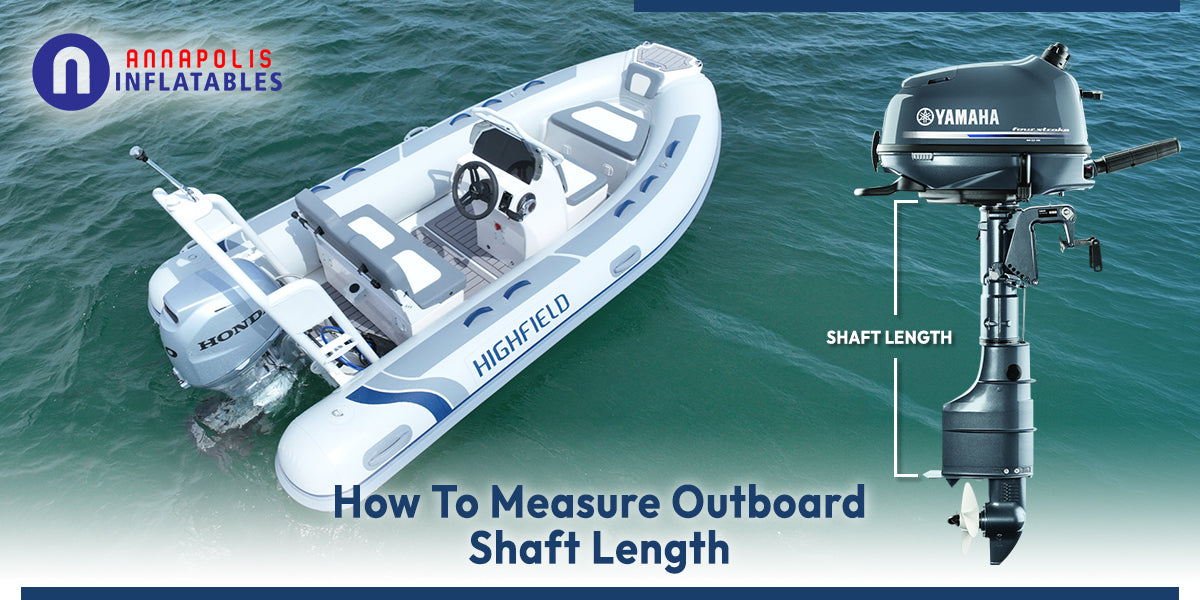
How to Measure Outboard Shaft Length
Table of Contents
- Short, Long, and Extra long-shafts: What the Terms Actually Mean
- How To Measure Outboard Shaft Length: Step By Step
- How To Measure the Shaft Length on an Outboard Motor That You Already Own
- Why Are Inflatables Different? What Rigid Hull Guides Don't Tell You
- Shaft Length Availability By Brand
- How To Verify The Shaft Length Is Correct Once The Motor Is Fitted
- Measure Once, Order Right
- Faqs
Outboard shaft length is one of the most frequently overlooked specifications when buying a motor for an inflatable boat. Many buyers assume the dealer will handle it or that the standard option will fit well enough. In practice, the wrong shaft length causes problems that cannot be corrected on the water.
A shaft that is too short allows the propeller to ventilate, drawing air rather than water, which causes a sudden loss of thrust, increases fuel consumption, and risks water ingestion at the gearcase. A shaft that is too long creates excessive drag at low speed and forces the motor to run at an angle that reduces efficiency and stresses the transom bracket.
This guide explains what shaft length means in practical terms, how to measure your transom correctly, what changes when the hull is an inflatable rather than a rigid boat, and how to verify the fit once the motor is mounted.
Short, Long, and Extra long-shafts: What the Terms Actually Mean
Outboard motor shaft length refers to the distance from the top of the motor's clamp bracket to the cavitation plate, the horizontal plate above the propeller. This is not the full height of the motor. The clamp bracket sits on top of the transom, so the shaft length determines how far the gearcase and propeller extend below the hull.
Four shaft designations cover the range relevant to inflatable boat owners:
| Designation | Shaft length (inches) | Shaft length (mm) | Typical use and motor examples |
|---|---|---|---|
| Short (S) | 15" | 381 mm | Small portable outboards up to 20 HP.Common on Tohatsu MFS2.5C through MFS20E, Yamaha F2.5 through F20,Suzuki DF2.5A through DF20A,Mercury 6 through 20 HP portable range. |
| Long (L) | 20" | 508 mm | Mid-range portables from 15 HP upward. Standard on Tohatsu MFS25D through MFS140A, Yamaha F25 through F150, Suzuki DF25A through DF200A, Mercury 25 through 150 HP. |
| Extra Long (XL) | 25" | 635 mm | Larger outboards on deeper transoms. Available on selected Tohatsu BFT series, Yamaha F150 and above, Mercury mid-range and above.Confirm availability at point of order. |
| Ultra Long (UL) | 30" | 762 mm | High-HP commercial and patrol outboards. Tohatsu BFT250D and equivalent large-frame motors.Confirm against the boat specifications before ordering. |
The most important clarification for buyers:
Short and long do not refer to the overall motor size. A short-shaft Tohatsu MFS25D and a long-shaft MFS25D are the same motor with different lower unit lengths. The HP, weight distribution, and powerhead dimensions are identical. Only the lower unit shaft changes.
How To Measure Outboard Shaft Length: Step By Step

The measurement that determines the correct shaft length is the transom height, from the top of the transom to the bottom of the hull at the transom, measured at the centerline. The process takes under five minutes and requires only a tape measure.
Step 1:
Inflate the tubes to the correct operating pressure before measuring. On an inflatable boat, the tube inflation level affects the effective transom height; a partially inflated tube can read 1 to 2 inches lower than the correct figure. Always measure at full operating pressure.Step 2:
Stand the boat on a flat surface or in the water at the launch position. The measurement must reflect how the boat sits when in use, not how it sits deflated or partially inflated on a trailer.Step 3:
Measure from the top of the transom plate, the rigid fiberglass or aluminum panel the motor clamps onto, straight down to the bottom of the hull at the centerline. On inflatable boats with a soft floor, measure to the lowest point of the hull when inflated. On aluminum or fiberglass hull RIBs, measure to the keel or bottom of the rigid hull at the transom.Step 4:
Match the measurement to the shaft designation using the reference table above. The goal is to position the cavitation plate 1 to 2 inches below the bottom of the hull when the motor is trimmed to the neutral running position. This places the propeller in clean, undisturbed water without excessive depth.Step 5:
If your transom has multiple motor mounting hole heights, confirm which position you will use and factor the height difference into your measurement.Using the wrong set of holes can effectively change the shaft requirement by an inch or more.
How To Measure the Shaft Length on an Outboard Motor That You Already Own
If you are measuring a motor you already own, for example, when verifying compatibility with a new boat, measure from the top of the clamp bracket to the cavitation plate. This gives you the shaft designation in inches, which you can then compare against the new boat's transom height. This is also the correct method when buying a used motor where the shaft designation is unknown or missing from the documentation.
Why Are Inflatables Different? What Rigid Hull Guides Don't Tell You
Most outboard shaft length guides are written for rigid hull boats, fiberglass runabouts, aluminum tinnies, and hardtops with fixed transom dimensions. Inflatable boats introduce variables that rigid-hull guides do not address.
1. Tube inflation affects effective transom height
On a rigid hull, the transom height is fixed regardless of any other condition. On an inflatable, the tube inflation level changes the effective transom height and the motor's running angle. An under-inflated inflatable sits lower at the stern, which both changes the transom height measurement and alters the angle at which the motor runs.
Tip: Always measure at the correct operating pressure, and always check tube pressure before launching, not just before measuring.
For more on how tube pressure affects inflatable hull performance and fuel efficiency, see our outboard maintenance tips to improve fuel efficiency.
2. Load sensitivity
Inflatable hulls sit differently at the transom under different load conditions. A fully loaded tender with crew and gear sits lower at the stern than the same boat running light solo. A shaft length calibrated for the loaded condition may place the propeller too deep when running unloaded, creating drag and reducing efficiency. Conversely, a shaft set up for light solo use may ventilate under full crew load.
Tip: Measure and specify shaft length based on your typical operating load, not the lightest or heaviest case.
3. Transom height by boat type
While individual models vary and your specific boat's spec sheet always takes precedence, the following gives a useful starting point for common inflatable types:
- Zodiac Cadet series (Aero, Alu, RIB Alu), typically suits short-shaft (15 inch) motors
- Zodiac Nomad RIB Alu, typically suits short to long-shaft depending on model size; confirm against the spec sheet
- Highfield Classic and Ultralite tenders typically suit a short-shaft
- Highfield Sport and larger RIBs typically suit a long-shaft
- Zodiac Medline series typically suits a long-shaft across the range
- Zodiac X10CC, long-shaft and above; confirm engine pre-rig specification
Note: Always confirm against your specific model.
The references above are starting points only. Transom height varies between sizes within the same model family; a Zodiac Nomad 2.7 and a Nomad 3.9 have different transom heights. Always confirm against the manufacturer's spec sheet for your exact model before ordering a motor.
4. Aftermarket transom brackets
If you are fitting a motor to an aftermarket transom bracket rather than the original transom, measure the effective transom height with the bracket in place rather than assuming it matches the standard transom. Aftermarket brackets vary significantly in height and can shift the effective shaft requirement by a full designation in either direction.
Shaft Length Availability By Brand
Shaft length must be confirmed at the point of order. The same motor model is typically available in multiple shaft lengths, and the correct designation cannot be changed after purchase without replacing the lower unit, a cost that significantly exceeds the original price difference between shaft options. The table below covers the four gas outboard brands stocked at Annapolis Inflatables.

For specific shaft length availability on any motor model in the Tohatsu, Yamaha, Mercury, or Suzuki range, contact the Annapolis Inflatables team before ordering. Our specialists confirm the correct shaft for your specific boat and motor combination before the order is placed.
How To Verify The Shaft Length Is Correct Once The Motor Is Fitted

Even with careful measurement, verifying the fit after installation confirms the motor is set up correctly before the first full outing.
Visual Check at Rest
With the motor mounted, tubes at operating pressure, and the boat on the water at rest, look at the motor from the side at the transom level. The cavitation plate should sit approximately 1 to 2 inches below the hull bottom. If the cavitation plate is at or above the hull bottom, the shaft is too short. If it is more than 3 inches below, the shaft may be longer than necessary for the transom height.
Signs The Shaft Is Too Short
- The propeller ventilates or cavitates at speed, a sudden loss of thrust accompanied by a rise in engine RPM without a corresponding increase in boat speed
- The motor loses thrust in tight turns where the hull rolls and the transom rises slightly
- Spray or water ingestion at the gearcase at speed
- Reduced efficiency and increased fuel consumption compared to manufacturer specifications
Signs The Shaft Is Too Long
- Excessive drag at low speed and during acceleration, the boat feels sluggish getting onto plane
- The propeller runs deeper than necessary, increasing water resistance without a performance benefit
- Poor fuel economy despite correct propeller pitch and motor tune
- The motor contacts the hull or transom at full trim-up position
WOT RPM Check
After verifying the visual fit, confirm the motor reaches its manufacturer-specified wide-open throttle RPM range under your typical operating load. A motor running below the specified RPM range under full throttle suggests either a shaft issue affecting propeller efficiency or an incorrectly pitched propeller.
For a full guide to propeller selection and RPM matching, see our complete propeller guide for inflatable boat owners.
Measure Once, Order Right
Shaft length is a fixed specification. Once the motor is ordered and delivered, changing it requires a lower unit replacement that costs more than the shaft option difference at the point of purchase. The five minutes spent measuring the transom correctly, accounting for tube inflation level and typical load, and confirming the shaft designation with your dealer is the most cost-effective outboard decision you can make.
To confirm the correct shaft length for your specific inflatable and motor combination before ordering, contact the Annapolis Inflatables team or request a quote at Annapolis Inflatables.
FAQs
Can I use a long-shaft motor on a short-shaft transom with an extension bracket?
Technically yes, but it is not recommended as a primary solution. Transom extension brackets add height to a short transom to accommodate a long-shaft motor, but they change the motor's running angle and leverage on the transom, which can affect handling and increase stress on the transom fittings.
What if I run a short-shaft motor on a deep transom?
The cavitation plate sits at or above the bottom of the hull, which means the propeller draws air rather than water at speed. This causes ventilation, a sudden loss of thrust, and, in severe cases, allows water ingestion at the gearcase. Running a short-shaft motor on a deep transom consistently causes premature wear on the gearcase seals and water pump and risks more serious mechanical failure over time.
Does shaft length affect fuel consumption?
Yes, indirectly. A shaft that is too short causes propeller ventilation, which forces the engine to work harder for the same thrust, increasing fuel consumption. A shaft that is too long creates additional drag at the gearcase and propeller, which also increases the fuel required to maintain speed.
How do I know if my current shaft length is correct without measuring?
The clearest on-water indicators are propeller behaviour at speed and WOT RPM. If the propeller occasionally loses grip and the engine RPM spikes without a speed increase, the shaft is likely too short. If the boat feels slow to plane and fuel consumption is higher than expected for the motor size, the shaft may be too long. For a definitive check, measure the transom height and compare it to the cavitation plate position with the motor fitted; 1 to 2 inches below the hull bottom is the correct position.


 Powered by goodChatBot