
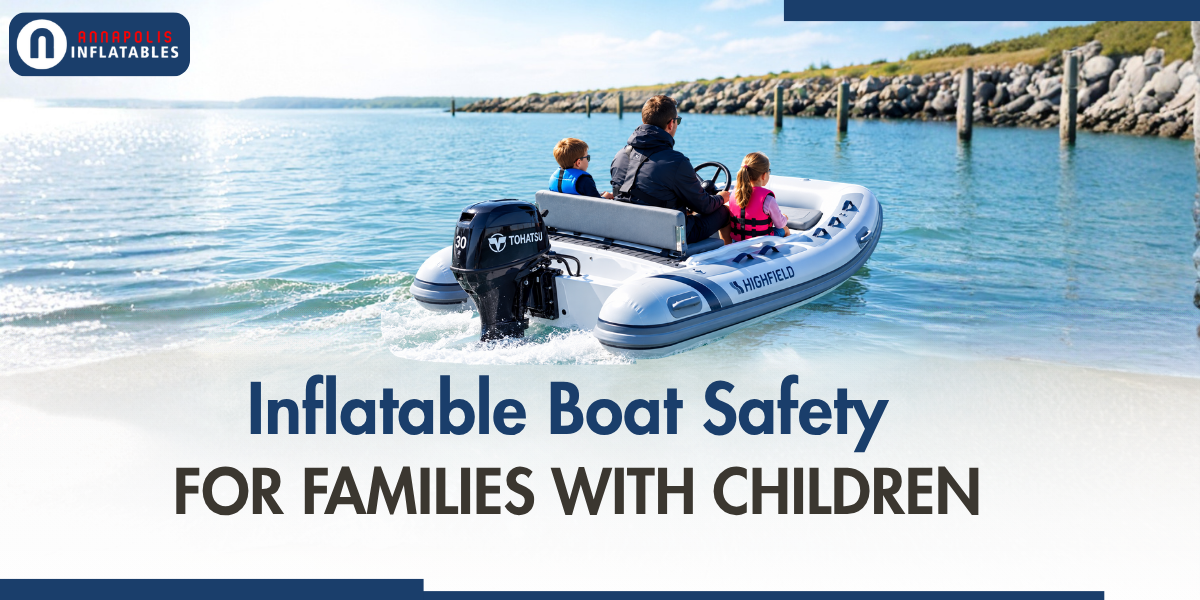
Inflatable Boat Safety for Families with Children
A practical safety guide for parents who already own an inflatable and want to use it confidently with children of all ages, from infants to teenagers.
Taking children on an inflatable boat is one of the most enjoyable experiences a family can have on the water. It is also one that requires more preparation than most parents initially anticipate. Inflatables introduce specific safety considerations that rigid hull boats do not: tube pressure directly affects stability, the open deck format leaves children continuously exposed, and boarding from the water requires different technique when small children are involved.
This guide covers everything families need to know to use their inflatable boat safely with children, organized by practical scenario and age group.
LEGAL REQUIREMENT:
Federal law (33 CFR 175.15(c)) under USCG regulations requires children under 13 to wear a Coast Guard approved PFD at all times on a moving vessel unless below deck or in an enclosed cabin. Inflatables have no below-deck option, this requirement applies throughout every outing.
Table of Contents:
- Before You Launch: Preparation Specific To Families
- PFDs: The Non-Negotiable
- Boarding And Exiting With Children: Inflatable-Specific Technique
- On The Water: Rules For Children By Age Group
- If A Child Goes Overboard: What To Do
- Building Good Safety Habits From The First Outing
- Frequently Asked Questions
Before You Launch: Preparation Specific To Families

The pre-launch checklist for a family outing on an inflatable is different from an adults-only trip. Five preparation steps apply specifically when children are aboard.
Check tube pressure
A child moving suddenly, standing up, reaching over the side, or shifting weight unexpectedly, creates a dynamic load that a correctly inflated tube absorbs and a soft tube amplifies. Check tube pressure before every family outing without exception.
For consistent pressure management between outings see our guide to automatic tube pressure maintenance.
Count your passengers correctly
Children count as passengers for the boat's rated capacity. A boat rated for six persons does not become a seven-person boat because one passenger is a child. In practice, a family outing with young children should use significantly less than maximum rated capacity, the unpredictable movement of children creates load shifts and stability demands that a full adult crew would not. Do not treat the maximum passenger capacity as a target. When children are aboard, consider the boat's available space, passenger weight, equipment load and how much movement the children are likely to make.
Assess weather conditions honestly
Wind chop, wake from passing vessels, and tidal current all affect an inflatable differently with children aboard than with adults. A 12-inch wake that an adult crew absorbs without concern can destabilize a young child who is not braced and expecting it. Set a lower threshold for acceptable conditions when children are aboard than you would for an adult-only outing. If the Bay is building afternoon chop, shorten the outing or stay in protected water.
Give Someone Ashore Your Float Plan
Always leave a float plan with someone ashore when children are aboard. The float plan should include your departure location, intended route, expected return time, number of people aboard including children's ages, and an emergency contact number. A float plan costs nothing and provides a critical reference point for search and rescue if something goes wrong.
Sun and heat preparation
Inflatable boats offer minimal shade. Infants and young children are particularly vulnerable to heat because they rely on adults to keep them cool and hydrated. On an inflatable with limited shade, keep young children out of prolonged direct sun, offer appropriate fluids, use lightweight protective clothing and watch closely for signs of overheating. Apply broad-spectrum sunscreen before boarding, not at the water, and reapply every 90 minutes. Bring more water than you think you need. Limit outing duration during peak summer heat hours on the Chesapeake Bay, typically 11am to 3pm, for outings with young children.
PFDs: The Non-Negotiable
A PFD is the single most important piece of safety equipment aboard any boat carrying children. On an inflatable, where there is no cabin, no below-deck space, and no guardrails, it is the only thing between a child who goes overboard and a serious outcome.
Why inflatable PFDs are not appropriate for children
Automatic inflatable PFDs, the slim, comfortable type adults often prefer, are not appropriate for young children. Automatic inflatable PFDs require the wearer to be conscious and physically capable of either pulling an inflation cord or entering the water to trigger water-activated inflation. A child who goes overboard unconscious, face-down, or in a panic cannot reliably deploy an inflatable PFD. Children should wear foam-filled PFDs only, buoyancy that works immediately regardless of the child's state or response.
PFD selection by age and weight
| Age group | Weight range | PFD to look for | What to check |
|---|---|---|---|
| Infant | 33 lb or less | USCG-approved infant PFD | Head support, secure fit and crotch strap; choose a model specifically approved for the child's weight |
| Child | Over 33 to 55 lb | USCG-approved child PFD | Snug fit, crotch strap and appropriate buoyancy; check the manufacturer's weight range |
| Youth | Over 55 to 88 lb | USCG-approved youth PFD | Snug fit and appropriate weight range; confirm the PFD does not ride up when tested |
| Adult-sized | Over 88 lb | USCG-approved adult PFD | Check both weight and chest-size requirements on the PFD label |
The Mustang Lil Legends Child Foam Vest, available at Fawcett Boat Supplies, is a Coast Guard approved foam PFD designed specifically for children. It provides the immediate buoyancy and secure fit that children's safety on an inflatable requires.
The PFD fit test
A PFD that fits correctly in a store may fit differently on the water. Before the first outing with a new PFD, perform the lift test: fasten the PFD correctly, lift the child by the shoulders of the PFD, and confirm the PFD does not ride up above the child's chin or ears. If it does, the PFD is too large and needs to be replaced with the correct size. Repeat this test at the start of each season as children grow.
PFDs must be worn, not stored
A PFD in a dry bag under the bow does not save a child who goes overboard. The PFD goes on at the car, not at the dock, not on the boat. Children who put their PFD on as part of the routine before leaving the parking area accept it as a normal part of the outing. Children who are asked to put it on at the water associate it with restriction and resist it. Build the habit correctly from the first outing.
Boarding And Exiting With Children: Inflatable-Specific Technique

Boarding and exiting are the moments of highest risk on any boat outing with children. On an inflatable, the low freeboard and flexible tube structure require specific technique that differs from boarding a rigid hull vessel.
Boarding from a dock
One adult boards the inflatable first and moves to a stable position before any child boards. The adult then receives each child individually from another adult on the dock. Never hand a child directly onto an unoccupied inflatable from a dock, an inflatable without an adult aboard to distribute weight and provide a stable anchor point can shift unpredictably as a child steps on. Children should board one at a time, never simultaneously.
Boarding from the water
Children should never attempt to board an inflatable from the water without an adult actively assisting. The inflatable's low freeboard makes assisted boarding from the water more achievable than from a rigid hull, but the process requires coordinated technique to avoid capsizing. An adult in the water supports the child while another adult aboard stabilizes the inflatable and assists the child over the tube. Never leave an inflatable unanchored during a water boarding process with children.
Exiting to the water: establishing the rule
Establish a clear and consistently enforced rule before the first outing: no child enters the water without explicit verbal permission from a supervising adult, regardless of how shallow the water appears, how calm the conditions are, or how urgently the child wants to swim. This rule matters most at anchor and during beach landings where the temptation to jump in is highest. Enforce it every time without exception, rules that have exceptions are not rules.
Infants and toddlers: designated hold at all times
An infant or toddler must be physically held by a designated adult throughout boarding, transit, and exiting. Not supervised, held. The designated adult's sole responsibility during these moments is the infant. They are not also operating the motor, managing lines, or assisting other children. Assign the designated adult role explicitly before every outing and do not change it mid-trip without a deliberate handover.
Propeller awareness at the transom
Establish a clear keep-clear zone around the transom and motor for children at all times, before boarding, during the outing, and when exiting. A propeller does not need to be running to cause injury; the lower unit and gearcase are hard, sharp-edged components at child height. The keep-clear zone applies whether the motor is running, idling, or off.
On The Water: Rules For Children By Age Group
The rules for children on an inflatable during transit and at anchor vary significantly by age. What is appropriate supervision for a teenager is inadequate for a toddler. The following guidance is organized by age group to reflect those differences.
Infants And Toddlers: 0 To 4 Years
- One designated adult holds the child at all times while underway, no independent sitting or placement on the floor of the boat during transit
- Calm, protected water only, infants cannot brace or respond to sudden movement from wake or chop. Bay anchorages in protected creeks and coves are appropriate; open Bay crossings in any wind are not
- Limit outing duration, infants overheat rapidly and cannot communicate discomfort effectively. Shorten your outing duration if the child shows any signs of heat distress.
- No outing if the child is unwell, fever, dehydration, or illness significantly increases risk on the water
Young Children: 5 To 10 Years
- Seated position rule: children remain seated while the boat is moving. No standing, no moving between seats underway, no leaning over the tubes
- Establish physical boundaries before launching: point out where children may and may not move on the boat while it is in the water. Reinforce these boundaries at the start of every outing, not just the first one
- Sun reapplication: reapply sunscreen every 90 minutes. The reflective surface of the water significantly accelerates UV exposure beyond what children experience on land
- Swimming rules at anchor: establish clearly when entering the water is permitted, always with adult supervision and always in PFD until the child is a confirmed strong swimmer in calm conditions
- Wake awareness: warn children before accelerating, decelerating, or when a wake from another vessel is approaching. A seated child who is not expecting sudden movement is far less likely to fall than one who has been warned
Pre-Teens And Teenagers: 11 To 17 Years
- PFD compliance is non-negotiable regardless of swimming ability: establish this from the first outing rather than attempting to introduce it with older children who have not worn PFDs previously
- Introduce responsibility gradually: older children who assist with basic tasks such as line handling, fender deployment, or anchor retrieval are more engaged and safer than bored teenagers looking for stimulation
- Propeller education: teenagers old enough to be near the motor should understand propeller danger explicitly and specifically. Never enter the water near a running or recently stopped outboard. This is not a general warning, it is a specific instruction that should be delivered as a fact, not a suggestion
- Establish a clear rule about operating the motor: if teenagers are permitted to operate the motor under supervision, define the conditions explicitly. If they are not, state that clearly before the first outing and do not change the position mid-season
If A Child Goes Overboard: What To Do

The correct response to a child overboard situation is a sequence, not a reaction. Knowing the sequence before it is needed makes the difference between an effective rescue and a panicked one.
- Stop the motor immediately: before any rescue attempt. A running propeller near a person in the water is the primary danger in a man-overboard situation. Kill the motor first.
- Maintain visual contact: designate one adult to keep eyes on the child in the water continuously while another manages the boat. Do not lose sight of the child.
- Throw before you go: throw a throwable PFD, a line, or any floating object toward the child before any adult enters the water. A child wearing a correctly fitted foam PFD will be face-up and floating: the priority is getting a line to them, not swimming to them.
- Approach from downwind and downcurrent: approach the child with the wind and current behind you so the boat drifts toward rather than away from them.
- Assisted boarding from the water: use the technique established for boarding from the water. One adult in the water supports the child; another aboard stabilizes the inflatable and assists the child over the tube.
Practice this sequence with older children so they know what to do if they go in, call out, stay calm, float on their back, and wait for the boat to come to them. A child who panics and swims away from the boat is harder to recover than one who floats and waits.
Building Good Safety Habits From The First Outing
The families who have the safest and most enjoyable time on the water with children build the right habits from the very first outing so the rules become routine rather than restriction.
Consistency from outing one
Children who learn the safety rules on their first boat trip accept them as a normal part of boating. Children who are introduced to rules after several outings without them experience the rules as a change, and resist accordingly. The PFD goes on at the car. Seated while moving. Ask before entering the water. These three rules, applied consistently from the first trip, become automatic within a season.
Model the behavior
Adults who wear PFDs, check tube pressure before launching, leave a float plan, and make conditions assessments out loud set the standard children observe and internalize. Children notice when adults follow their own rules and when they do not. The most effective safety instruction on a family boat is not the briefing at the dock, it is the behavior the adults demonstrate on every outing.
Age-appropriate involvement
Children who have a genuine role on the boat are safer than bored children looking for stimulation. A five-year-old can hold a line. A ten-year-old can watch for other boats. A teenager can handle the anchor. Involvement creates investment in the outing's success, reduces restlessness, and builds the boat awareness that makes older children genuinely safer crew members over time.
Planning more family days on the water? Find an inflatable boat that fits your crew at Annapolis Inflatables.
Frequently asked questions
At what age can a child go on an inflatable boat?
There is no minimum age set by federal law for children as passengers on a recreational boat. In practice, infants are taken on inflatables regularly by experienced boating families in calm, protected conditions.
Do children have to wear a life jacket on an inflatable boat?
Under current USCG federal regulations, children under 13 are required to wear a Coast Guard approved PFD at all times on a moving recreational vessel unless they are below deck or in an enclosed cabin. Inflatable boats have no below-deck option, the requirement applies throughout every outing.
Is an inflatable boat safe for a toddler?
Yes, in the right conditions with the correct preparation. Calm, protected water; a correctly fitted infant or child PFD with head support and crotch strap; a designated adult whose sole responsibility is holding the child throughout the outing; and an honest assessment of conditions before launching.
What is the best life jacket for a child on an inflatable boat?
A foam-filled, Coast Guard-approved PFD sized to the child's weight, not their age.


 Powered by goodChatBot