
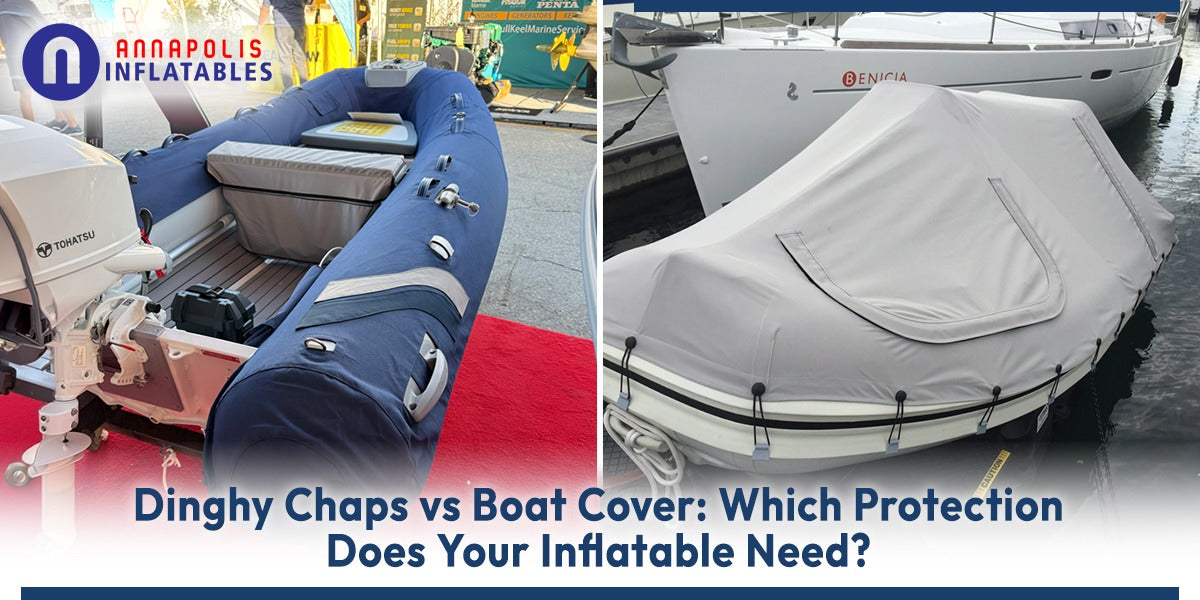
Dinghy Chaps vs Boat Cover: Which Protection Does Your Inflatable Need?
Table of Contents:
- Why Inflatable Boat Tubes Need Protection
- What Are Dinghy Chaps?
- What Are Boat Covers?
- Dinghy Chaps vs Boat Cover: Key Differences
- Inflatable Boat Cover vs Dinghy Chaps: Which Do You Need?
- How to Protect an Inflatable Boat Year-Round
- Custom Highfield Dinghy CHAPS from Annapolis Inflatables
- Choose the Right Protection for Your Inflatable
- Frequently Asked Questions
Your inflatable’s tubes take a beating every season. Sun, dock edges, beach sand, fuel spills, and winter weather all wear down PVC and Hypalon over time, and tube repairs are far more expensive than prevention.
That is why so many owners end up weighing dinghy chaps vs boat cover. Both protect your boat, but they do very different jobs at very different times. Chaps protect the tubes while you use the boat. A cover protects the whole boat while it sits.
This guide explains what each one does, where each falls short, and how to decide which protection your inflatable actually needs.
Why Inflatable Boat Tubes Need Protection
The tubes are the most exposed part of any inflatable, and most of the damage they suffer is slow and preventable. These are the main threats:
- UV exposure: Sunlight breaks down tube fabric over time. Both PVC and Hypalon are affected, but PVC is far more vulnerable. Owners commonly report PVC tubes fading, turning sticky, or degrading after a few seasons of regular sun.
- Chafe and abrasion: Dock edges, pilings, exposed nails, other boats’ outboards, and davit contact points all rub against the same tube areas, again and again.
- Beach landings and sand: Dragging a dinghy up a beach scuffs the tubes, and sand trapped in fabric folds can wear small pinholes that are hard to repair.
- Fuel and chemicals: Spilled fuel and oil attack tube fabric and seams, especially on PVC.
- Weather in storage: Rain, snow, leaves, bird droppings, and trapped moisture all cause problems when a boat sits unused for weeks or months.
Hypalon (CSM) tubes resist UV and chemicals much better than PVC, but no tube fabric is immune. Protection simply buys you more years before patching or retubing.
Related: Why Go with Hypalon over PVC for Your Dinghy? and How to Make Your Inflatable Boat or RIB Last Longer
What Are Dinghy Chaps?
Dinghy chaps are custom-fitted fabric covers that wrap the inflatable tubes and stay on while you use the boat. They shield the tube surfaces from UV, chafe, and abrasion, leaving the floor, transom, and interior open so the boat works normally.
Because tube shapes differ from model to model, chaps are not a one-size product. They are patterned to a specific boat so they sit tight and do not shift underway.
What Dinghy Chaps Protect Against
- UV damage to the top and sides of the tubes
- Abrasion from docks, pilings, and other boats
- Scuffs from beach landings and shallow-water operation
- Wear at davit and lifting contact points
- Wear during trailering and transport

Benefits of Dinghy Chaps
- They take the damage instead of your tubes. A scuffed or worn chaps panel is easier and cheaper to deal with than a damaged tube.
- They stay on. No setup before each trip and no cover to stow aboard.
- They help extend tube life, which matters most on PVC boats and boats kept in the sun.
- They protect resale value by keeping tubes in better condition.
Limitations of Dinghy Chaps
- They cover the tubes only. The floor, console, seats, and motor stay exposed to rain and weather.
- Poorly designed chaps can trap water underneath and add drag, so a proper fit and drainage at the stern matter.
- The chaps fabric wears over time and will eventually need repair or replacement.
- They are not a winter storage solution on their own.
What Are Boat Covers?
A boat cover is a full-length fabric cover that goes over the entire boat when it is not in use. On an inflatable, it typically wraps over the tubes and cinches underneath them with a drawstring or straps, protecting the tubes, floor, console, seating, and often the outboard.
Common Types of Inflatable Boat Covers
- Storage or mooring covers: For a boat parked in a driveway, yard, or slip between uses.
- Trailerable covers: Built with heavier fabric and more tie-down points so they stay secure at highway speed.
- Off-season covers: For long-term outdoor storage through fall and winter, ideally used with a support pole so water and snow run off instead of pooling.
Benefits of Boat Covers
- Protect the whole boat, not just the tubes
- Keep out rain, snow, leaves, pollen, and bird droppings
- Block UV from the floor, seats, console, and electronics as well as the tubes
- Help keep animals out of a stored boat
Limitations of Boat Covers
- They come off every time you use the boat, so they do nothing while you are on the water or tied to a dock.
- They do not protect against chafe from docks, pilings, or beaching.
- A loose or storage-only cover can balloon and tear on the highway, so trailering needs a cover rated for it.
- Without ventilation, a cover can trap moisture and lead to mildew, especially if the boat was put away wet or dirty.

Dinghy Chaps vs Boat Cover: Key Differences
The simplest way to separate them: chaps protect the boat in use, and covers protect the boat in storage.
| Feature | Dinghy Chaps | Boat Cover |
|---|---|---|
| What it protects | Tube tops and Rubrail sides | Entire boat: tubes, floor, console, seats, often the motor |
| When it is used | On the boat while in use, left on | When the boat is parked, stored, or trailered |
| Main threats handled | UV, dock chafe, beach abrasion, davit wear | Rain, snow, debris, UV, animals |
| Use on the water | Yes | No |
| Fit | Custom to the boat model | Universal, semi-custom, or custom |
| Daily effort | None once installed | Put on and take off every use |
| Watch out for | Water trapped under poorly designed chaps | Mildew without ventilation, ballooning if not trailer-rated |
| Best for | Tenders and inflatables used often from docks, beaches, and davits | Off-season storage, trailered boats, boats parked outdoors between trips |
Inflatable Boat Cover vs Dinghy Chaps: Which Do You Need?
The right answer depends on how you use and store your inflatable. Most owners fall into one of these situations.
Choose Dinghy Chaps If
- You use your inflatable as a tender and tie up at crowded dinghy docks.
- You regularly land on beaches or run in shallow, rocky water.
- Your boat hangs on davits or sits on a swim platform in the sun.
- You own a PVC boat and want it to last as long as possible.
- You want protection that stays on without daily setup.
Choose a Boat Cover If
- Your boat sits on a trailer or in a yard for days or weeks between trips.
- You want to protect the floor, seats, console, and motor, not just the tubes.
- You need off-season protection from rain, snow, and debris.
- You trailer the boat and need a cover rated for highway use.
Why Many Owners Use Both
For most active boaters, it is not a strict either-or choice. Chaps handle the boating season, and a cover or shrink wrap handles the off-season. In a climate like the Chesapeake Bay, with a busy summer season and a cold, wet winter, this combination gives the tubes year-round protection.
How to Protect an Inflatable Boat Year-Round
Chaps and covers work best as part of a simple care routine. These steps make the biggest difference:
- Rinse with fresh water after use, especially after saltwater trips, and remove sand from the floor and tube seams.
- Clean the tubes regularly with a cleaner made for inflatable boat fabric. Avoid harsh solvents that can damage PVC or Hypalon.
- Apply a UV protectant to exposed tube areas. It helps, but it wears off and needs reapplying, so it works best alongside chaps rather than instead of them.
- Fit dinghy chaps for the boating season to protect the tubes from sun, docks, and beach landings.
- Check tube pressure and inspect seams so small problems get fixed before they become leaks.
- Make sure the boat is clean and dry before covering it. Salt, dirt, and moisture trapped under a cover speed up mildew and fabric wear.
- Use a ventilated cover or professional shrink wrap for the off-season, set up so rain and snow run off instead of pooling.
- Store indoors or in a managed storage facility when possible. Covered outdoor storage works, but it is a compromise compared with a protected, monitored space.
- Schedule professional inspection and repair for slow leaks, worn seams, or valve problems before the next season.
Related: Winter Boat Storage Prep Checklist: What to Do Before You Drop-Off and How to Dewinterize Your RIB for Spring Boating
Custom Highfield Dinghy CHAPS from Annapolis Inflatables
If you own a Highfield, Annapolis Inflatables offers Custom Highfield Dinghy CHAPS patterned to specific Highfield models.
- Compatible models: Highfield Classic models, all Highfield Sport RIB models, and the Ultralite 310 and Ultralite 340. CHAPS are not offered for the Ultralite 220, 240, 260, and 290, because those tubes do not have the lip the CHAPS need.
- Material: Marine-grade SUNTECh fabric, chosen for UV resistance, saltwater durability, breathability, and easy cleaning.
- Installation: Wrap-style fastening with straps, buckles, or zippers. No glue and no drilling.
- Options: Blue or gray, with or without a bow step, ordered by model and model year so the fit is correct.
Pricing is by quote. Share your Highfield model and model year to get started. For more detail on how CHAPS reduce long-term wear, read our guide on how CHAPS extend the life of your Highfield Classic tender.
Off-Season Storage and Protection
For the off-season, Annapolis Inflatables storage at our Bay Ridge Road facility in Annapolis offers secure, monitored outdoor storage billed monthly by boat size. Optional add-ons include winterization, shrink wrapping, detailing, bottom painting, and repairs.
Related: Where to Find Reliable Winter Boat Storage Space in Annapolis?
If your tubes already show wear or a slow leak, our inflatable boat maintenance and repair services cover all brands.
Choose the Right Protection for Your Inflatable
When it comes to dinghy chaps vs boat cover, the question is less about which is better and more about when your boat needs protecting. Chaps guard the tubes every time you use the boat. A cover guards the whole boat while it waits. For most owners, using both across the year gives the tubes the longest life.
Own a Highfield? Request a quote for custom Highfield Dinghy CHAPS, or contact Annapolis Inflatables about off-season storage, shrink wrapping, and inflatable boat repair.
Frequently Asked Questions
What are dinghy chaps?
Dinghy chaps are custom-fitted fabric covers that wrap an inflatable boat’s tubes and stay on during use. They protect the tubes from UV, chafe, and abrasion from docks, beaches, and davits.
What are boat covers?
Boat covers are full-length covers that go over the entire boat when it is parked, stored, or trailered. They protect the tubes, floor, seats, console, and often the motor from rain, snow, debris, and sun.
Are dinghy chaps better than a boat cover?
Neither is better overall, because they solve different problems. Chaps protect the tubes while you use the boat, and a cover protects the whole boat while it sits. Many owners use chaps in season and a cover or shrink wrap in the off-season.
Can I use dinghy chaps and a boat cover together?
Yes. A cover can go over a boat fitted with chaps for storage. For long-term winter storage, ask your dealer whether the chaps should stay on or come off before covering or shrink wrapping.
Are dinghy chaps worth it on a Hypalon boat?
Yes for many owners. Hypalon resists UV better than PVC, but it still wears from sun, dock chafe, and beaching. Chaps help extend tube life on both materials, with the biggest benefit on PVC.
Do dark-colored chaps make the tubes too hot?
Generally not. A sailmaker’s test published in Cruising World found little difference in tube surface temperature under dark chaps compared with bare tubes.
Can I tow my inflatable with a cover on?
Only with a cover designed for trailering and secured to both the boat and the trailer. A standard storage cover can balloon and tear at highway speed.
How do I protect an inflatable boat over winter?
Clean and dry it fully, inspect the tubes and seams, then store it under a ventilated cover or professional shrink wrap, ideally in a secure, managed facility.


 Powered by goodChatBot