
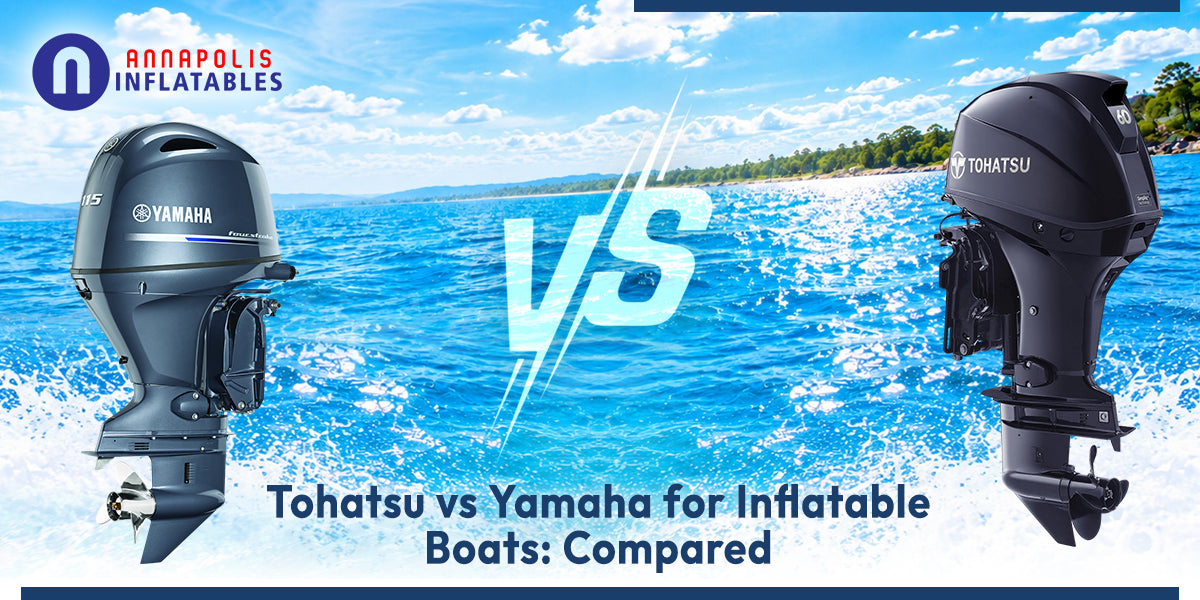
Tohatsu vs Yamaha for Inflatable Boats: Compared
Table of Contents
- Tohatsu and Yamaha outboard motor for inflatable boat at a glance
- What each brand offers for inflatable boat owners
- Key differences between Tohatsu and Yamaha for inflatable boat owners
- How each brand of outboard motor for inflatable boat performs on an inflatable hull
- Which Brand Suits Which Buyer: Use Case Matrix
- The Conclusion
- FAQ on Tohatsu vs. Yamaha for Inflatable Boats
Tohatsu and Yamaha are two of the most widely chosen outboard brands for inflatable boats, and for good reason. Both are four-stroke-first manufacturers with proven reliability records, comprehensive dealer networks, and model ranges that cover the full HP spectrum relevant to inflatable use. Choosing between them is rarely a question of quality. It is a question of which brand suits your specific setup, use case, and what your local dealer stocks and services.
Annapolis Inflatables is an authorized dealer for both brands, stocking 22 Tohatsu models from the MFS2.5C to the BFT250D, and 19 Yamaha F-series models from the F2.5 to the F250. Both ranges are fully serviced and warranty-supported on site. That means whichever brand you choose, you have the same level of local support behind it.
This guide compares both brands across the factors that matter specifically to inflatable boat owners, not offshore powerboat buyers, and gives a clear recommendation matrix by use case.
Tohatsu and Yamaha outboard motor for inflatable boat at a glance

Tohatsu Outboard Motor
Founded in 1922, Tohatsu is Japan's oldest outboard motor manufacturer. Their MFS four-stroke series covers 2.5 HP to 250 HP continuously, from the MFS2.5C through MFS3.5C, MFS4D, MFS6D, MFS8C, MFS9.8C, and upward. Many MFS models are among the lightest in their class, which is a direct advantage for inflatable boat owners where transom load and one-person handling matter.
Tohatsu motors also comes in three jet drive variants, the MFS25AJET, MFS35AJET, and MFS40AJET. These suit shallow water, tidal flat, and river use where a conventional propeller would be at risk.
Yamaha Outboard Motor
Yamaha is the world's largest outboard manufacturer by revenue and global presence. Their F-series four-strokes have set the benchmark for recreational outboard reliability for decades. The range from the F2.5 to the F250, 19 models cover every practical HP range for inflatable use. Yamaha's global service network is the broadest in the industry, which matters for owners who travel with their boats or spend extended time away from their home port.
Yamaha outboards introduced EFI earlier across their range than most competitors and the F-series benefits from decades of refinement in that system. Their mid-range models, F25 through F90, are among the most commonly specified outboards for inflatable RIBs in the recreational market.
What each brand offers for inflatable boat owners
Both brands cover the full HP range relevant to inflatable use, with no meaningful gaps between 2.5 HP and 250 HP.

Tohatsu additionally offers three jet drive variants, the MFS25AJET, MFS35AJET, and MFS40AJET, at 25, 35, and 40 HP. These have no Yamaha equivalent and suit shallow water, tidal flat, and river use where a conventional propeller would be at risk.
Key differences between Tohatsu and Yamaha for inflatable boat owners

1. Weight
Weight matters more on an inflatable than on a rigid hull. It affects transom load, one-person handling on the dock, and balance on lightweight tenders where a heavy motor changes the running attitude significantly.
Tohatsu MFS portable models are among the lightest four-strokes in their class. The MFS2.5C weighs 13.2 lbs, exceptionally light for a four-stroke. At the critical 15 to 25 HP range for inflatable tenders and small RIBs, Tohatsu generally comes in slightly lighter than the equivalent Yamaha F-series model. For owners where every kilogram on the transom matters, yacht tender use, small inflatable, or davit weight limits, this difference is worth factoring in.
Yamaha F-series motors are not heavy by any measure, but they are typically slightly heavier at equivalent HP. At higher HP ranges, F50 and above, the difference becomes less relevant as both brands are in a similar weight class and the boats carrying them are rated for the load.
2. Fuel efficiency
Both brands deliver comparable fuel economy at equivalent HP when properly maintained. The meaningful difference is in the fuel delivery system, carbureted versus EFI, rather than brand.
In the Tohatsu range, smaller portables from MFS2.5C to MFS6 are carbureted. From MFS8 upward, Tohatsu uses EFI across the MFS range. In the Yamaha range, EFI is standard from the F4 and above. This means Yamaha offers EFI at slightly lower HP entry points than Tohatsu, which is relevant for owners of very small inflatables who want the starting and efficiency benefits of EFI on a compact motor.
For carbureted Tohatsu models in the small portable range, fuel stabilization before storage and carburetor maintenance between seasons are more important considerations than with EFI equivalents. See our outboard maintenance tips for inflatable boat owners for what this involves in practice.
3. Starting reliability
Both brands have excellent reputations for reliable starting across their EFI ranges. EFI motors from both Tohatsu and Yamaha start consistently in cold conditions without manual choke adjustment, one of the main advantages of EFI over carbureted systems for inflatable owners who launch in variable weather.
In the carbureted small portable range, primarily the Tohatsu MFS2.5C through MFS6, cold starting requires more attention than EFI models. This is not a Tohatsu-specific weakness; it is characteristic of carbureted outboards across all brands. If reliable cold starting in variable temperatures is a priority and you are considering a motor below 10 HP, Yamaha's EFI coverage from the F4 upward gives it a starting consistency advantage in this HP range.
4. Jet drive availability
This is the clearest differentiator between the two brands for specific inflatable use cases. Tohatsu's MFS25AJET, MFS35AJET, and MFS40AJET have no Yamaha equivalent in the inflatable-relevant range. Jet drive outboards eliminate the exposed propeller entirely, making them the correct choice for shallow tidal flats, crabbing grounds, rocky river launches, and any environment where propeller strikes are a frequent risk.
For Chesapeake Bay boaters who regularly access shallow tributaries, crab pot areas, or grassy shallows, the Tohatsu jet drive option is a practical advantage that Yamaha cannot match in this HP range.
5. Parts and service network
Yamaha has the broadest global outboard service and parts network in the industry, a genuine advantage for owners who travel extensively with their boats or spend time in locations away from their home dealer. Yamaha parts are stocked at a wider range of marine dealers worldwide than any other brand.
Tohatsu has a strong and growing US dealer and parts network. For owners based in the Annapolis and Chesapeake Bay region who service their motor locally, both brands are equally supported at Annapolis Inflatables, parts, warranty work, and annual servicing are available on site for both.
6. Warranty
Both Tohatsu and Yamaha are sold with manufacturer warranty through certified dealers. Specific warranty terms vary by model and are confirmed at the time of purchase. For current warranty details on any model in either range, contact the Annapolis Inflatables team directly when requesting a quote.
7. Maintenance requirements
Annual maintenance requirements are comparable between the two brands at equivalent HP and fuel system type. EFI models from both ranges have similar service intervals, spark plug replacement, gear oil change, impeller replacement, and fuel filter service. Carbureted Tohatsu portables require seasonal carburetor attention that EFI models do not.
Both brands are fully serviced at Annapolis Inflatables, including winterization, annual service, and warranty repairs. For what owner maintenance is feasible between professional services, see our guide to DIY outboard motor repairs.
How each brand of outboard motor for inflatable boat performs on an inflatable hull
Throttle Response And Low-Speed Handling
On a lightweight inflatable hull, where small throttle inputs produce immediate speed changes, smooth, linear throttle response matters more than on a heavier rigid boat. Both brands deliver good throttle response across their EFI ranges. Yamaha's F-series EFI has a particularly well-regarded idle quality and low-speed consistency, which suits owners who spend time maneuvering in tight marina conditions or alongside a yacht at anchor.
Tohatsu MFS EFI models deliver comparable low-speed smoothness from MFS15E upward. At the smaller HP ranges where Tohatsu is carbureted, throttle response is less linear than EFI but adequate for the low-speed use typical of tenders and small inflatables.
Planing Performance On Inflatable Hulls
Inflatable hulls plane at lower speeds than equivalent rigid boats due to their lighter weight and buoyancy characteristics. Both brands plane inflatables quickly and cleanly in the correct HP range. Where the brands differ slightly is in how their weight distribution affects running trim on small tenders.
Tohatsu's lighter motor weight at equivalent HP means the transom sits slightly higher when running light, which benefits planing speed on small tenders but may require trim adjustment on larger loaded RIBs. Yamaha's slightly heavier motors at mid-range HP provide marginally more stern stability under load, which can benefit larger inflatables carrying passengers and gear in chop.
Saltwater And Estuarine Durability
Both brands are built for marine environments and perform equally well in the saltwater and brackish conditions typical of Chesapeake Bay and its tributaries. The maintenance requirements after saltwater use are identical for both, fresh water flushing after every outing, anode inspection, and annual cooling system service. Neither brand has a meaningful advantage here; what matters is consistent maintenance regardless of brand.
For Chesapeake Bay and estuarine use specifically, the Tohatsu jet drive models offer a practical advantage in shallow or debris-laden water that no Yamaha model in this HP range can match.
Which Brand Suits Which Buyer: Use Case Matrix
| Use case | Yamaha | Tohatsu | Either |
|---|---|---|---|
| Small tender (under 10 ft) | F2.5 · F4 · F6 · F8, F15, F20 EFI from F4, wider HP options | MFS2.5C · MFS3.5C · MFS6, MFS8, MFS9.8, MFS15, MFS20 lightest in class. | - |
| Yacht tender (10–12 ft) | F9.9 · F15 · F20, consistent EFI, proven reliability | MFS9.8C · MFS15E · MFS20E, lighter weight advantage | Either, both excellent in this range |
| Family day boat (12–15 ft) | F25 · F30 · F40, broad HP selection, smooth EFI | MFS25D · MFS30D · MFS40A, comparable performance | Either, choose on weight preference |
| Fishing, shallow water | F25 · F40, standard propeller drive | MFS25AJET · MFS35AJET · MFS40AJET, jet drive for tidal flats | Tohatsu for shallow/jet drive; Yamaha for deeper water |
| Watersports / performance RIB | F50 · F60 · F75 · F90, strong mid-range, power trim options | MFS50A · MFS60A · MFS75A · MFS90A, comparable performance | Either, both suit this use case well |
| Commercial / patrol inflatable | F115 · F150 · F200 · F225 · F250 | MFS115A · MFS140A · BFT150D–BFT250D | Either, confirm HP rating against boat plate |
Summary of the Table:
Who should choose Tohatsu Outboard Motors
- Weight is a primary consideration, small tender, davit limits, or one-person handling
- Shallow water, tidal flat, or river use where a jet drive is the right tool
- Broadest portable range from 2.5 HP with no gap above 9.8 HP
- Value-conscious buyer who wants dealer-certified support without premium brand
Who should choose Yamaha Outboard Motors
- EFI coverage from F15 HP upward, best for buyers wanting EFI at very low HP
- Broadest global parts and service network, relevant for travelling owners
- Premium brand positioning matters, Yamaha carries strong resale recognition
Both brands at one dealer
Not sure which brand suits your inflatable? Bring your boat's spec sheet, typical crew load, and use case to Annapolis Inflatables. Our team will recommend the right motor from either range. Both brand’s outboard motors are stocked and fully serviced on site. Explore Tohatsu and Yamaha outboard motors now!
The Conclusion
Neither brand is universally better. Tohatsu's weight advantage and jet drive availability make it the stronger choice for specific inflatable applications, particularly small tenders where every kilogram matters and shallow water environments where jet drive is essential. Yamaha's EFI coverage at lower HP, broader global service network, and premium brand recognition make it the stronger choice for buyers who want the most widely supported motor on the market with EFI from the smallest sizes up.
For the majority of inflatable owners in the 15 to 90 HP range, the sweet spot for most Chesapeake Bay RIBs and tenders, both brands are equally matched and the decision comes down to personal preference, weight sensitivity, and which models are available in the configuration you need.
To request a quote on any Tohatsu or Yamaha model, visit Annapolis Inflatables or speak with our team directly.
FAQ on Tohatsu vs. Yamaha for Inflatable Boats
Is Tohatsu as reliable as Yamaha for inflatable boat use?
Yes, both brands have strong reliability records in the recreational inflatable market. Tohatsu's MFS four-stroke series and Yamaha's F-series are both designed for marine environments and serviced to the same standards at Annapolis Inflatables. The reliability difference between a well-maintained Tohatsu and a well-maintained Yamaha is negligible. The maintenance you perform, flushing after saltwater use, annual service, gear oil changes, has more impact on long-term reliability than brand choice.
Can I use the same propeller on a Tohatsu and Yamaha of the same HP?
No, propellers are brand and model-specific. The spline count, shaft diameter, and gearcase dimensions differ between Tohatsu and Yamaha even at the same HP. Always confirm propeller compatibility with the specific motor model before purchasing. For a full guide read our guide to propeller selection for inflatable boats.
Which brand holds its resale value better?
Yamaha generally holds resale value slightly better in the broader used outboard market due to its larger global brand recognition and wider buyer pool. Tohatsu motors hold value well in the US coastal market where the brand has strong dealer presence. In practice, a well-maintained motor from either brand at the same HP and age will sell at comparable prices in the Annapolis and Chesapeake Bay area.
Does it matter which brand I choose if I'm mainly using it on the Chesapeake Bay?
Both brands are equally well-suited to Chesapeake Bay conditions, saltwater, brackish tributaries, and seasonal temperature variation. Both are fully serviced at Annapolis Inflatables, so local support is identical. The only Chesapeake-specific factor that tips the decision is shallow water use, if you regularly access shallow tidal flats, grassy shallows, or creek mouths where propeller strikes are a risk, Tohatsu's jet drive models (MFS25AJET, MFS35AJET, MFS40AJET) are the only option between the two brands that addresses this.


 Powered by goodChatBot