
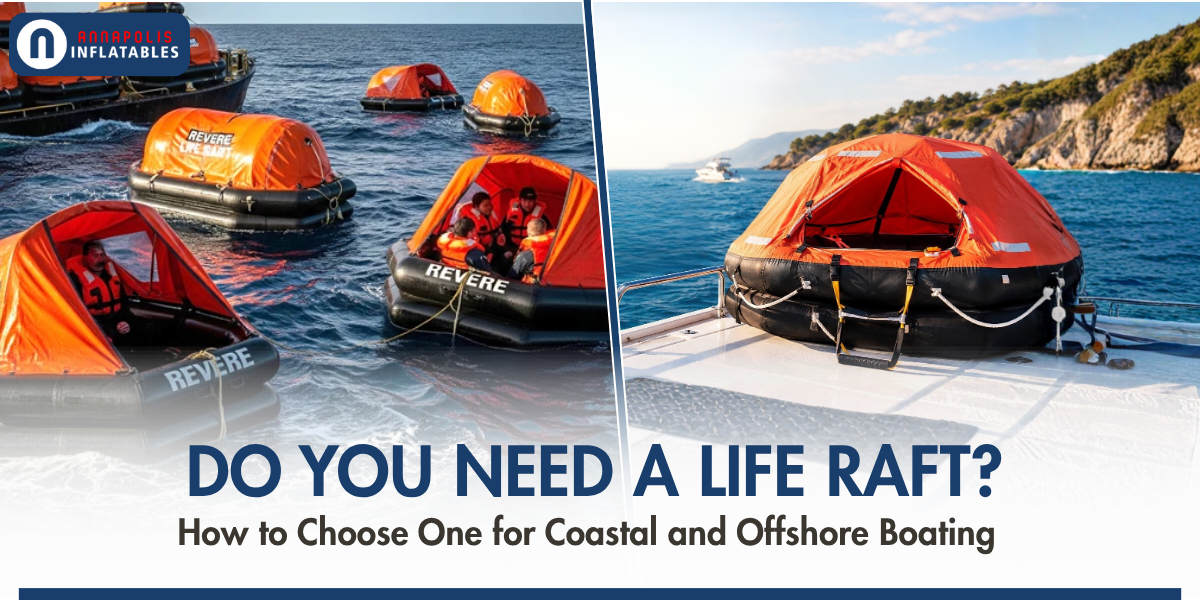
Do You Need a Life Raft? How to Choose One for Coastal and Offshore Boating
A life raf is not legally required on recreational boats in the United States, but it becomes essential safety equipment once you head offshore, cross open water, or boat where rescue could take hours to arrive. The right raft depends on three things: how far from help you boat, how many people are aboard, and where you can mount or stow it.
This guide explains how a life raft works, the real difference between a coastal and an offshore life raft, why your dinghy cannot do the same job, and how to choose a life raft that fits your boat and the way you use it.
Key Takeaways
- The U.S. Coast Guard does not require life rafts on recreational boats, but it recommends considering one if you boat offshore or where rescue is not close at hand.
- Coastal (Type 2) life rafts suit near-shore boating where rescue is expected within 24 hours. Offshore (Type 1) life rafts are built for open water, stronger winds, and longer waits.
- A life raft inflates automatically from a gas cylinder when its painter line is pulled, and a hydrostatic release unit can launch it on its own if the boat sinks.
- An inflatable tender or dinghy is not a substitute for a life raft in rough conditions.
- Choose a raft sized for your usual crew, not the largest possible crew, and budget for professional servicing.
Table of Contents
- Do You Need a Life Raft for Your Boat?
- How Does a Life Raft Work?
- Coastal vs Offshore Life Raft: What Is the Difference?
- Life Raft vs Dinghy: Can Your Tender Replace a Life Raft?
- How to Choose a Life Raft: 7 Factors to Consider
- How Much Does a Life Raft Cost to Own?
- Offshore Boating Safety Equipment to Carry with Your Life Raft
- Life Rafts Available at Annapolis Inflatables
- Where Can You Buy a Coastal or Offshore Life Raft in Annapolis?
- Frequently Asked Questions
Do You Need a Life Raft for Your Boat?
You need a life raft if you boat far enough from shore that help may not reach you quickly. For recreational boaters in the U.S., carrying one is a choice, not a federal requirement, regardless of boat size. The Coast Guard’s guide to federal requirements for recreational boats recommends that boaters heading offshore, or into areas where rescue is not close at hand, consider a life raft large enough for everyone aboard, fitted with the right emergency equipment pack, and serviced according to the manufacturer’s instructions.
Rules change once you leave purely recreational boating. Commercial fishing vessels and inspected passenger vessels have their own survival craft requirements, and many offshore races and cruising rallies require a life raft through their safety regulations, such as the World Sailing Offshore Special Regulations.
A life raft makes sense for your boat if any of these apply:
- You run offshore or cross large, open bodies of water.
- You boat in early spring, late fall, or winter, when water temperatures are low.
- You make overnight passages or trips where you are hours from the nearest harbor.
- You take part in offshore races or rallies that list a raft in their equipment rules.
- You regularly carry guests or family members who would struggle to stay afloat in the water.
Why Cold Water Changes the Equation
Water draws heat away from the body about 25 times faster than air at the same temperature. Cold water researcher Dr. Gordon Giesbrecht summarizes the danger with the 1-10-1 rule: about 1 minute to get your breathing under control after the initial cold shock, about 10 minutes of meaningful movement before your muscles stop working properly, and up to about 1 hour before hypothermia causes unconsciousness. A life raft gets everyone out of the water, which is the single biggest factor in surviving that timeline.
If you are still deciding whether a raft belongs on your boat, our life raft collection covers the coastal and offshore options we carry, along with answers to common deployment and maintenance questions.
How Does a Life Raft Work?
A life raft is a tightly packed inflatable craft that fills itself with gas in seconds when its painter line is pulled. The painter line is the rope that connects the raft to your boat. Pulling it to its full length fires a compressed gas cylinder, usually carbon dioxide, sometimes mixed with nitrogen, which inflates the buoyancy tubes and, on most models, the canopy arch.
There are two ways a life raft can be launched.
Manual Deployment
This is how most recreational life rafts are used:
- Secure the end of the painter line to a strong point on the boat before doing anything else.
- Release the raft from its cradle or remove it from its locker, and launch it over the side, ideally on the downwind (leeward) side.
- Pull the painter line out until it reaches its full length.
- Give the line a hard, sharp tug. This fires the gas cylinder and the raft inflates.
- Board the raft carefully, ideally stepping directly from the boat to stay dry.
- Cut the painter only once everyone is aboard and you are safely clear of the vessel.
Automatic Float-Free Deployment
Container-mounted rafts can be fitted with a hydrostatic release unit (HRU). If the boat sinks before the crew can launch the raft, water pressure triggers the HRU at a depth of no more than about 4 meters (roughly 13 feet). The HRU cuts the straps holding the container in its cradle, and the container floats to the surface.
As the boat continues to sink, the painter line pulls out to its full length and fires the inflation cylinder. Once the raft inflates, its buoyancy breaks a deliberately weak link in the line, so the sinking boat cannot drag the raft down. Correctly rigging the painter through the weak link is essential, and an incorrectly rigged painter is one of the most common faults inspectors find.
What Keeps a Life Raft Stable
Under the floor, a life raft carries ballast bags, which are weighted pockets that fill with seawater as soon as the raft hits the water. The weight of that water beneath the raft holds it down against wind and waves and reduces the chance of a capsize. A four-person raft commonly has four ballast bags, each holding roughly 55 to 75 liters of water.
Coastal vs Offshore Life Raft: What Is the Difference?
A coastal life raft is designed for sheltered or near-shore waters where rescue is expected within 24 hours. An offshore life raft is built for open water, stronger winds, larger waves, and the possibility of waiting longer than 24 hours for rescue. Offshore rafts are typically sturdier, better insulated, heavier, and more expensive.
Understanding the ISO 9650 Standard
Most recreational life rafts are built to ISO 9650, the international standard for inflatable life rafts on small craft up to 24 meters long. The current edition, ISO 9650-1:2022, covers both raft types in a single standard and replaced the older ISO 9650-1:2005 (offshore) and ISO 9650-2:2005 (coastal) documents. You will still see older rafts and some product listings labeled ISO 9650-2, which refers to the previous coastal standard.
- Type 1 (offshore) Life rafts are intended for offshore use, where strong winds and significant wave heights can be expected.
- Type 2 (coastal) Life rafts are intended for more sheltered waters where moderate conditions are expected, such as coastal waters, large bays, estuaries, lakes, and rivers.
Type 1 rafts are further divided by temperature. Group A rafts are designed to inflate in air temperatures from -15°C to +65°C (5°F to 149°F) and have an insulated double floor. Group B rafts cover 0°C to +65°C (32°F to 149°F) with a single floor.
Rafts also come with different emergency equipment packs. A pack for rescue expected within 24 hours contains basic survival and signaling items, while a pack for rescue expected after more than 24 hours adds more equipment, including food and water rations.
For commercial vessels, SOLAS (the International Convention for the Safety of Life at Sea) sets a separate and more demanding standard. SOLAS rafts are generally more than a recreational boat needs, unless you run a charter, fishing, or other commercial operation with its own requirements.
Coastal vs Offshore Life Raft Comparison
| Feature | Coastal Life Raft (Type 2) | Offshore Life Raft (Type 1) |
|---|---|---|
| Intended waters | Coastal waters, bays, estuaries, lakes, rivers | Offshore and open ocean |
| Expected conditions | Moderate wind and sea | Strong winds and significant waves |
| Typical rescue time | Within 24 hours | May exceed 24 hours |
| Floor | Single floor | Insulated double floor (Group A) |
| Equipment pack | Basic, short-duration pack | Under or over 24 hour pack options |
| Weight and size | Lighter, more compact | Heavier, bulkier |
| Cost | Lower | Higher |
| Best for | Bay cruising, near-shore fishing, day trips | Offshore passages, ocean races, cold-water boating |
Which One Fits the Way You Boat?
If most of your boating happens on protected waters like the Chesapeake Bay and you are rarely more than a few hours from help, a coastal raft is usually the practical choice. It is lighter, easier to store, and less expensive to buy and maintain.
If you run offshore, make ocean passages, race in events that require a Type 1 raft, or boat in cold water, choose an offshore raft. The Revere Offshore Commander 4.0, for example, is manufactured to ISO 9650 for offshore conditions and includes an insulated floor, a boarding ramp, and a rainwater collection system.
Life Raft vs Dinghy: Can Your Tender Replace a Life Raft?
No. An inflatable tender or dinghy is not a reliable substitute for a life raft, except possibly in calm water close to shore. A dinghy is built for everyday transport. A life raft is built for one job: keeping people alive in the conditions that sank their boat.
The UK’s Royal Yachting Association calls the idea that a half-inflated tender on deck can replace a life raft a common misconception. A tender might help in a fire on a calm day, but it is a poor second choice if the boat must be abandoned quickly or in anything other than very calm weather. Rigid dinghies in particular often capsize and float upside down in heavy seas.
| Feature | Dinghy or Tender | Life Raft |
|---|---|---|
| Main purpose | Daily transport, going ashore | Emergency survival |
| Deployment | Manual launch, may need inflating | Inflates automatically in seconds |
| Shelter | Usually open | Canopy against wind, spray, and sun |
| Stability in rough seas | Can capsize | Ballast bags resist capsizing |
| Survival equipment | None unless you add it | Packed emergency equipment |
| Float-free option | No | Yes, with an HRU on container models |
| Servicing | Routine care | Professional inspection and repacking |
The best approach offshore is to carry both. Your tender remains your everyday boat for reaching the dock or the beach, and it can act as a backup in the right conditions. Your life raft is your dedicated survival craft. If you are still deciding on a tender, our comparison of the Zodiac Cadet Aero, Cadet Alu, and Cadet RIB Alu walks through three popular options.

How to Choose a Life Raft: 7 Factors to Consider
Choosing a life raft comes down to matching the raft to where you boat, who is aboard, and how your boat is laid out. Work through these seven factors in order.
1. Where You Boat
Start with your typical cruising area and your longest likely trip. Coastal boaters who stay near rescue points can choose a Type 2 raft. Anyone boating offshore, in cold water, or in races that specify a Type 1 raft should choose an offshore model.
2. Capacity
Match the raft to the number of people you normally carry, not the largest crew you might ever take. A raft that is too big for its occupants is less stable, because the people inside act as part of the ballast. If you usually boat as a couple with occasional guests, a four-person raft is often the right size. If your crew size varies a lot, two smaller rafts can be easier to store and launch than one large one.
3. Container or Valise
Life rafts are packed in either a hard container (canister) or a soft valise (bag).
- Containers Mount on deck in a cradle, protect the raft from weather, and can be fitted with an HRU for automatic float-free launch. They are heavier and need dedicated deck space.
- Valises are lighter and stow in a dry cockpit locker or below deck, which also protects them from sun and theft. However, someone must lift the bag and get it to the rail in an emergency.
If you choose a valise, make sure the smallest adult aboard can lift and launch it. The VIKING RescYou Coastal six-person valise raft is one compact option designed for coastal boaters with limited deck space.
4. Emergency Equipment Pack
Match the pack to your likely rescue time. Short coastal trips generally only need the basic pack. Offshore passages call for a more complete pack, and many offshore sailors also carry a separate ditch bag with extra water, signaling devices, and communications gear.
5. Certification
Look for a raft built to ISO 9650 (Type 1 or Type 2) for recreational use. If you race, check your event’s notice of race and equipment rules before buying, because some events require a specific type, temperature group, or equipment pack.
6. Service Interval and Service Access
Manufacturers recommend having your life raft professionally inspected and repacked at set intervals, and VIKING and Revere both recommend servicing every three years. The Revere Coastal Commander 4.0 carries no dated goods, so it is designed to be paired with your own ditch bag. Before buying, confirm that a certified service station for that brand is within reach.
7. Budget
Factor in the full cost of ownership, not just the purchase price. Servicing, replacement parts, and eventual replacement all add up over the life of the raft, as the next section explains.
How Much Does a Life Raft Cost to Own?
Recreational life rafts range from under $2,000 for a basic coastal raft to several thousand dollars for a larger offshore raft, depending on capacity, type, and packaging. Coastal rafts in a valise sit at the lower end of that range, while offshore rafts in a deck container sit at the higher end. Commercial SOLAS rafts cost more.
| Cost Factor | What to Expect |
|---|---|
| Purchase price | Under $2,000 for basic coastal rafts, up to several thousand dollars for larger offshore rafts |
| Servicing | Recommended every three years by VIKING and Revere; cost depends on size, age, and parts replaced |
| Lifespan | Typically 10 to 15 years with proper storage and servicing |
| Rental | A certified, professionally packed raft for a single passage or race, priced by size, type, and rental period |
| Mounting | A cradle and, if desired, an HRU for container rafts |
If you only head offshore once or twice a season, renting a professionally packed raft for those trips can be more economical than owning one.
To get the full lifespan from your raft, store a valise somewhere dry and protected from extreme temperatures, keep containers clean and secure in their cradle, and never skip a service date. The same principles apply to the rest of your gear, and our guide on how to make your inflatable boat or RIB last longer covers storage and care habits for your tender.
Life Raft Servicing and Recertification
Regular servicing is what keeps a life raft ready to deploy when it matters. Both VIKING and Revere recommend servicing and recertifying their life rafts every three years at an authorized service station. During a service, technicians unpack the raft, inspect it inside and out, run a 60-minute pressure test on the buoyancy chambers, weigh the gas cylinder to confirm the correct charge, and replace any expired items in the emergency pack. The raft is then repacked, and the service is recorded in its logbook and certificate. As a raft ages, manufacturers also call for specific tests at set intervals. Revere, for example, performs a gas inflation test using the raft’s own cylinder every five years, and adds pressure and floor seam tests at 10 years, after which the raft moves to annual servicing.
Offshore Boating Safety Equipment to Carry with Your Life Raft
A life raft keeps you afloat, but it does not call for help. Offshore boating safety equipment works as a system, and the raft is only one part of it. Alongside your raft, carry:
- EPIRB (Emergency Position Indicating Radio Beacon): Sends a 406 MHz distress signal with your position to search and rescue authorities. In the U.S., 406 MHz beacons must be registered with NOAA.
- PLB (Personal Locator Beacon): A smaller beacon worn by an individual crew member.
- Handheld VHF radio with DSC: Waterproof, with a spare battery, for talking directly to rescuers and nearby vessels.
- Life jackets for everyone aboard: Required by federal law on recreational boats, and essential when boarding a raft from the water. Our guide to inflatable boat safety for families with children covers life jacket rules and fit in more detail.
- Visual distress signals: Flares or approved electronic signals, which are required on most recreational boats operating on U.S. coastal waters.
- Ditch bag: A waterproof, buoyant, brightly colored bag with drinking water, a first aid kit, seasickness medication, a signal mirror, a flashlight, sunscreen, and copies of important documents.
- A means of accurately determining your position: A handheld GPS or a phone with navigation stored in a waterproof case.
Practice before you need it. Make sure everyone aboard knows where the raft and ditch bag are, how to launch the raft, and who is responsible for each task. Experienced offshore sailors follow one simple rule: only step up into a life raft. In other words, stay with your boat as long as it is safely afloat, because it offers more shelter and is easier for rescuers to spot than a raft.
Life Rafts Available at Annapolis Inflatables
Annapolis Inflatables carries life rafts from two trusted manufacturers, Revere and VIKING, for coastal boaters, offshore cruisers, and commercial operators.
| Life Raft | Type | Capacities | Packaging | Key Features |
|---|---|---|---|---|
| Revere Coastal Commander 4.0 | Coastal | 4 and 6 person | Valise or container | Dual tubes, automatic canopy, exterior and interior lights, 4 ballast bags, no dated goods |
| Revere Offshore Commander 4.0 | Offshore, ISO 9650-1 | 4, 6, and 8 person | Valise or container | Insulated floor, boarding ramp, rainwater collection, under 24 hour pack, 3-year inspection interval |
| VIKING RescYou Coastal | Coastal, Type 2 | 6 person | Valise | Designed for rescue within 24 hours, four 55-liter ballast bags, rainwater collector, automatic lights |
| VIKING 4DK+ and 6DK+ | Throw-overboard, commercial | 4 and 6 person | Rigid fiberglass container | Built to SOLAS and MED requirements, mainly for commercial, passenger, and fishing vessels |
Revere rafts are known for their lightweight design and efficient packaging, which makes them a strong fit for boats where storage space is limited. You can compare both models in the Revere life raft collection.
VIKING is one of the most widely recognized names in marine life-saving equipment. Its RescYou Coastal suits recreational boaters near rescue points, while its DK+ throw-overboard rafts are designed for commercial vessels with stricter requirements. See the full range in our VIKING life raft collection.

Where Can You Buy a Coastal or Offshore Life Raft in Annapolis?
Whether you need a life raft depends on where you boat, how far you are from help, and who is aboard. For bay and near-shore boating, a compact coastal raft provides peace of mind at a manageable cost. For offshore passages, cold water, and ocean racing, an offshore raft with an insulated floor and a fuller equipment pack is the safer investment.
Annapolis Inflatables makes choosing a life raft simple. Our team will help you compare coastal and offshore rafts, find the right size for your crew, and pick a mounting setup that works on your boat. Stop by 919 Bay Ridge Road in Annapolis, call (410) 267-8681, or contact us today to get started. The best time to choose a life raft is long before you ever need one.


 Powered by goodChatBot