
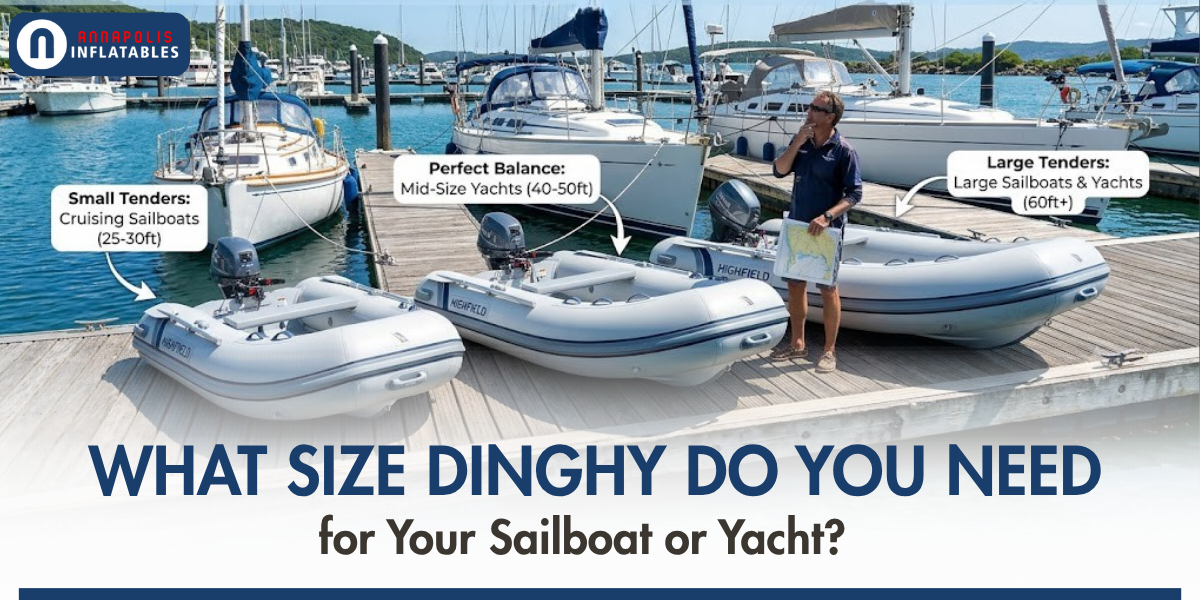
What Size Dinghy Do You Need for Your Sailboat or Yacht?
For most sailboats under 40 feet, a dinghy between about 8 and 10 feet long is the right fit. Larger sailboats and motor yachts usually carry tenders from 10 to 12 feet or more, often rigid inflatable boats (RIBs) with room for six or more people. The exact size depends on four things: how many people you carry, where you will store the dinghy, how you will lift or carry it, and what outboard you plan to run.
This guide answers “what size dinghy do I need for my sailboat?”, explains what size tender for a yacht makes sense, and walks through the storage, capacity, and outboard decisions that narrow the choice down to the right boat.
Key Takeaways
- Dinghy size follows boat size, but storage space and crew size matter more than any chart.
- A dinghy of about 8 feet 6 inches is enough for two or three people making short trips ashore. If you want to plane, choose one at least 9 feet long.
- Inflatable boats are exempt from the U.S. Coast Guard capacity label requirement, so the manufacturer’s maximum load and passenger rating is your limit.
- Measure your davits, deck, or locker before you shop, and include the outboard in every weight and length calculation.
- In Maryland, any boat operated with a motor, including a dinghy, must be titled and registered with the Department of Natural Resources.
Table of Contents
- What Size Dinghy Do I Need for My Sailboat?
- What Size Tender Do You Need for a Yacht?
- Sailboat vs Yacht: Why Their Tender Needs Differ
- How Many People and How Much Gear Will You Carry?
- Where Will You Store Your Dinghy?
- What Size Outboard Should Your Dinghy Have?
- Roll-Up, Air Floor, or RIB: Which Dinghy Type Fits Your Boat?
- Dinghy and Tender Options at Annapolis Inflatables
- Where Can You Buy a Dinghy or Yacht Tender in Annapolis?
- Frequently Asked Questions On What Size Dinghy Do You Need for Your Sailboat or Yacht?
What Size Dinghy Do I Need for My Sailboat?
There is no fixed formula, but most sailboat owners choose a dinghy that gets longer as the boat gets longer. Use the chart below as a starting point, then adjust for your crew, storage, and the distances you travel to shore.
| Sailboat Length | Typical Dinghy Length | Typical Crew in the Dinghy | Typical Outboard Range |
|---|---|---|---|
| Under 30 ft | 7 ft to 8 ft 6 in | 2 to 3 | 2.5 to 6 HP, or electric |
| 30 to 40 ft | 8 ft 6 in to 10 ft | 3 to 4 | 6 to 9.9 HP |
| 40 to 50 ft | 10 ft to 11 ft 6 in | 4 to 6 | 9.9 to 20 HP |
| Over 50 ft | 11 ft 6 in and up | 6 or more | 20 HP and up |
This chart is a general guideline. Always stay within the maximum horsepower and load ratings of the specific dinghy you choose.
If you are asking “what size dinghy do I need for my sailboat?” and your answer to “how far is shore?” is usually “a few hundred yards across a quiet harbor,” you can stay toward the smaller end of the range. If you anchor out in open water, carry a family, or haul provisions and dive gear, move up a size.
Why Dinghy Length Matters on the Water
Length changes how a dinghy behaves far more than most buyers expect. In Practical Sailor’s in-water testing, an 8 foot 6 inch boat was enough for two or three people motoring slowly from boat to shore, but the testers recommended a boat of at least 9 feet for anyone who wants to plane.
West Marine’s buying guidance makes a similar point. Sport boats under 9 feet can plane but tend to be twitchy and drop off plane easily, while 10 and 11 foot boats have less bow rise, stay on plane at lower speeds, and give a drier ride thanks to larger tubes.
The Most Common Dinghy Sizing Mistake
The most common mistake is buying the smallest dinghy that fits your storage space instead of the smallest dinghy that actually serves your needs on the water. A tender that is too small, too wet, and too slow tends to stay aboard while you look for other ways to get ashore. One size larger than your minimum is often the boat you will actually use.
What Size Tender Do You Need for a Yacht?
Most yacht tenders start at around 10 to 12 feet, and larger yachts often carry RIBs of 12 feet and up with a center console and seating for six or more. The answer to what size tender for a yacht depends less on the yacht’s length and more on how many guests you carry, how far you travel from the anchorage, and how the tender is launched and stored.
Compared with a cruising sailboat, a yacht’s tender usually has to do more:
- Carry more guests and luggage in a single trip.
- Cover longer runs from the anchorage to shore, fuel docks, or beaches.
- Tow water toys or support swimming and diving.
- Handle chop with a planing hull and a larger outboard.
Storage on a yacht is also different. Tenders are commonly carried on a swim platform, a hydraulic platform, or a flybridge with a crane, and superyachts often have stern garages for their tenders and water toys. Whatever the setup, the platform, crane, or garage rating sets the hard limit on tender size and weight.
For yachts with platform or flybridge storage, the Zodiac Yachtline series is designed as a dedicated yacht tender range. The Yachtline 360, for example, is 11 feet 10 inches long, rated for up to 40 HP, and carries up to four people.
Sailboat vs Yacht: Why Their Tender Needs Differ
In the debate over sailboat vs yacht, there is no strict legal definition that separates the two. “Yacht” is generally used for a larger pleasure vessel, under sail or power, built for comfort and longer trips. Many people begin calling a boat a yacht at around 35 to 40 feet, while the term superyacht usually applies to vessels over 24 meters (79 feet).
For dinghy buyers, the label matters less than the practical differences. When you compare sailboat vs yacht tender needs, the biggest factors are deck space, weight sensitivity, and how the boat moves underway.
| Factor | Sailboat | Motor Yacht |
|---|---|---|
| Typical storage | Stern davits, foredeck, cockpit locker, or towed | Swim platform, hydraulic platform, flybridge crane, or garage |
| Weight sensitivity | High; stern weight affects trim and sailing performance | Lower, but limited by platform or crane rating |
| Movement underway | Heels under sail, so the dinghy must be secured against swinging | Stays more level, but pounding in a seaway still loads the mounts |
| Common tender types | Roll-up, air floor, lightweight aluminum RIB | Larger RIB, often with a console |
| Common outboard range | Small and light, often under 10 HP | Larger outboards, often 20 HP and up |
On a sailboat, every pound hanging off the stern matters. On a motor yacht, the bigger question is whether the davit, the hydraulic platform or crane can safely handle the tender, the outboard motor, fuel, and gear together.

How Many People and How Much Gear Will You Carry?
Size your dinghy for the crew and gear you usually carry, not just the number of people aboard the mothership. If you typically go ashore with four adults, groceries, and a dog, a dinghy rated for four people with little spare load will feel cramped and sit low in the water.
Keep these points in mind:
- Follow the manufacturer’s rating. Federal capacity label rules in 33 CFR 183 cover monohull boats under 20 feet, but they exempt sailboats, canoes, kayaks, and inflatable boats. That means your inflatable dinghy will not carry a U.S. Coast Guard capacity plate, so the manufacturer’s maximum persons and maximum load ratings are the numbers to follow.
- Check what the load rating covers. Manufacturers define maximum load differently. Some include the outboard and fuel, while others cover only passengers and gear and list a separate maximum engine weight. Read the specification sheet for your model and stay within both limits.
- Plan for real trips. Provisions, water jugs, dive tanks, coolers, and pets all add up quickly.
- Inflatables carry more for their size. A hard dinghy of the same length typically has less stability and payload than an inflatable, and it has no built-in fendering to protect your topsides.
Where Will You Store Your Dinghy?
Measure your storage space before you shop, because storage often decides the final size of your dinghy. Write down the space available on your davits, deck, or locker, and include the outboard in every measurement.
Stern Davits
Davits are popular on cruising sailboats and powerboats because they keep the dinghy ready to launch. If you carry your dinghy on stern davits, it should be shorter than your boat’s beam at the transom, including the outboard, so nothing sticks out past the sides.
Weight is the other limit. BoatUS points out that two davit arms rated at 300 pounds each do not mean you can safely carry a 600 pound dinghy, because up to 75 percent of the combined dinghy and outboard weight sits at the stern of the dinghy. Add the weight of fuel, life jackets, and any gear you leave aboard when you lift it. BoatUS also notes that most davit failures happen when the dinghy is allowed to swing underway, so secure it firmly, especially on a sailboat that heels.
On Deck or Foredeck
Many sailors carry a RIB or folding-transom dinghy on the foredeck or coachroof for passages. A RIB with its tubes partly deflated takes up less room, but the rigid hull still needs dedicated deck space.
In a Locker
Roll-up and air floor dinghies pack down small enough to stow in a cockpit locker or lazarette. This is often the best option for smaller sailboats and for passages where you want the deck clear. If portability is your top priority, our guide to which inflatable boat is best for easy transport and storage compares folding, lightweight, and compact options side by side.
Swim Platform or Crane
On motor yachts, tenders usually ride on a swim platform, a hydraulic lift platform, or the flybridge with a crane. Check the rated capacity of the platform or crane and make sure the tender’s length and beam fit the space without blocking access.
Towing
Towing works for short hops in calm conditions, but it adds drag and puts strain on the tow point. Never leave an inflatable tied astern overnight in an open anchorage or in conditions where it could be swamped. A swamped dinghy becomes extremely heavy and can damage the mothership’s stern.
What Size Outboard Should Your Dinghy Have?
Match the outboard to the dinghy’s floor type and length, and never exceed the manufacturer’s maximum horsepower rating. Exceeding the rating is unsafe and can void the warranty, but an underpowered dinghy is just as frustrating, especially with two adults aboard in chop.
| Dinghy Type and Size | Typical Outboard Range |
|---|---|
| Roll-up dinghies | 2 to 3.5 HP |
| 9 to 10 ft sport boats and air floor boats | 6 to 9.9 HP, up to 15 HP on some models |
| 11 ft and larger sport boats and RIBs | 15 to 30 HP |
These ranges are general guidance. The right outboard for your dinghy is always within its specific maximum horsepower rating.
Outboard weight matters as much as power, because you will lift the motor on and off the dinghy and it adds to every davit load. Approximate dry weights for small four-stroke outboards are about 30 pounds for 2.5 HP, about 57 pounds for 6 HP, and about 95 pounds for 15 to 20 HP, depending on brand and model.
Electric outboards are another option for short, quiet harbor runs, and they remove the need to carry gasoline aboard. Our comparison of electric vs gas outboard motors covers range, weight, and horsepower recommendations by inflatable size.
Roll-Up, Air Floor, or RIB: Which Dinghy Type Fits Your Boat?
The floor type determines the trade-off between portability and performance, so choose it alongside the size.
| Dinghy Type | Best For | Storage | Planing Ability | Typical Outboard |
|---|---|---|---|---|
| Roll-up | Short harbor trips, occasional use at anchor | Rolls up into a cockpit locker | Does not plane | 2 to 3.5 HP |
| Air floor | Cruising sailors who need compact stowage and good performance | Packs small, quick to set up | Planes with suitable power | 6 to 9.9 HP |
| RIB (aluminum or fiberglass hull) | Daily use, open water, heavy loads, larger crews | Davits, deck, platform, or crane | Planes well and handles chop | 15+ HP and up, by model |
An air floor dinghy is a smart choice when space is tight. A 10 foot air floor boat stows in roughly the same space as an 8 foot sport boat with rigid floorboards, so you can often gain length without losing locker space.
Aluminum hull RIBs, such as Highfield’s UL & CL Series, combine a rigid hull with a lighter weight than many fiberglass RIBs of the same size. That makes them a popular choice for sailboats with davits and for owners who regularly land on beaches. If you are weighing several Highfield models against the way you boat, our guide on how to select the best Highfield inflatable boat for your activities covers yacht tenders, family use, fishing, and diving.
Dinghy and Tender Options at Annapolis Inflatables
Annapolis Inflatables carries tenders from Highfield, Zodiac, Achilles, and Walker Bay, covering everything from lightweight sailboat dinghies to full yacht tenders. The models below show how dinghy size lines up with boat size.
| Model | Length | Max People | Max HP | Best Fit |
|---|---|---|---|---|
| Highfield Ultralite 260 | 8 ft 6 in | 4 | 6 HP | Small sailboats, light davits, or locker storage |
| Highfield Classic 290 | 9 ft 6 in | 4 | 20 HP | Sailboats of about 30 to 40 ft |
| Highfield Classic 310 | 10 ft 2 in | 5 | 20 HP | Cruising couples and families |
| Highfield Classic 340 | 11 ft 2 in | 6 | 25 HP | Larger sailboats and small yachts |
| Zodiac Yachtline 360 | 11 ft 10 in | 4 | 40 HP | Yachts with platform or crane storage |
| Zodiac Yachtline 490 | 16 ft 1 in | 9 | 90 HP | Large yachts |
The Highfield Ultralite range is built for sailors who want the strength of an aluminum hull at a weight close to a soft-bottom dinghy. The Ultralite 260 weighs about 77 pounds, which makes it manageable on lighter davits or for lifting aboard by hand.
For most cruising sailboats, the Classic range is the sweet spot. Highfield describes the Classic 310 as the model that hits the “just right” balance for many owners, with an aluminum hull, lifting points, and a bow locker that fits a 24-liter fuel tank. You can compare the full lineup in the Highfield Classic collection.
Larger yachts that need more seating, more power, and a console will find stronger options in the Zodiac Yachtline range mentioned earlier.

Where Can You Buy a Dinghy or Yacht Tender in Annapolis?
Annapolis Inflatables helps sailors and yacht owners find the right tender for their boat. Our team can help you match dinghy size to your crew, check your storage and davit setup, and pair your tender with the right outboard. Stop by 919 Bay Ridge Road in Annapolis, call (410) 267-8681, or contact us today to start the conversation. The right dinghy is the one you will be happy to use every time you drop anchor.
Frequently Asked Questions On What Size Dinghy Do You Need for Your Sailboat or Yacht?
What size dinghy do I need for a 30 foot sailboat?
Most 30 foot sailboats are well served by a dinghy of about 8 feet 6 inches to 9 feet 6 inches. Choose the shorter end for short harbor trips with two people, and the longer end if you want to plane or regularly carry three or four people.
What size dinghy do I need for a 40 foot sailboat?
A 40 foot sailboat usually pairs well with a dinghy of about 9 feet 6 inches to 11 feet. A 10 foot RIB or air floor boat with a 6 to 9.9 HP outboard is a common choice for cruising couples and families.
What size tender do I need for a 50 foot yacht?
Yachts of 50 feet and up usually carry tenders of about 11 feet 6 inches or longer, often RIBs with a console. The swim platform, davit, or crane rating will set the maximum size and weight.
Can a dinghy be too big for my boat?
Yes. A dinghy that is too large or heavy can overload davits, affect your boat's trim and sailing performance, stick out past the transom, or be difficult to launch and recover. Always check storage dimensions and weight ratings first.
Do inflatable dinghies have a Coast Guard capacity plate?
No. Federal capacity label requirements exempt inflatable boats, so inflatable dinghies do not carry a U.S. Coast Guard capacity plate. Follow the manufacturer's maximum persons, maximum load, and maximum horsepower ratings.
Do I need to register my dinghy in Maryland?
Yes, if you use it with a motor. In Maryland, any vessel operated with a motor must be titled and registered with the Department of Natural Resources and display valid registration decals. Check with Maryland DNR for current requirements and fees.
How big does a dinghy need to be to plane?
For reliable planing, choose a dinghy of at least 9 feet with a rigid or air floor and an outboard suited to its rating. Roll-up dinghies with slatted floors are not designed to plane.
Is a roll-up dinghy or a RIB better for a sailboat?
It depends on storage and use. A roll-up or air floor dinghy suits smaller sailboats with limited deck space and short trips ashore. A RIB suits larger sailboats with davits or deck space, and owners who use the dinghy daily or cross open water.


 Powered by goodChatBot