
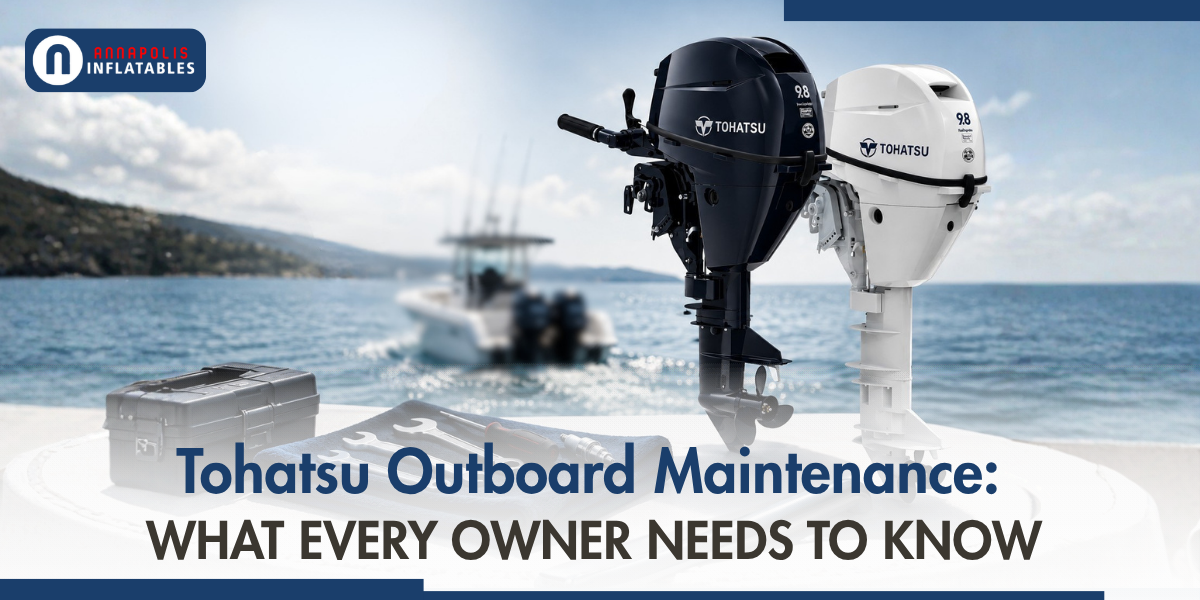
Tohatsu Outboard Maintenance: What Every Owner Needs to Know
Table of Contents
- Tohatsu MFS Maintenance Schedule: What To Do And When
- Tohatsu Range-Specific Maintenance: What Makes Each Range Different
- Tohatsu Saltwater Maintenance: Cleaning, Inspection, and Care
- Annual Professional Service At Annapolis Inflatables
- What to bring to your service appointment
- Frequently asked questions
The Tohatsu MFS four-stroke series is one of the lightest and most reliable portable outboard ranges available for inflatable boats. The full range spans 22 models from the MFS2.5C through to the BFT250D, covering everything from a 2.5 HP tender motor through to a 250 HP offshore powerplant. What they share across that range is a dependence on consistent, correctly timed maintenance to deliver the reliability and longevity they are built for.
This guide covers the maintenance tasks every Tohatsu owner needs to know, organized by frequency rather than by task. Where the Tohatsu range has model-specific maintenance considerations- carbureted versus EFI, jet drive versus conventional, MFS portable versus BFT series- those differences are called out specifically, so the guidance is accurate for your motor rather than generic.
Tohatsu MFS Maintenance Schedule: What To Do And When
The single most effective maintenance habit for any outboard is a consistent schedule. The table below organizes every key maintenance task by frequency, from pre-launch checks through to annual service and seasonal lay-up.
| Frequency | Tasks |
|---|---|
| Before every outing | Tell-tale water flow check after start; visual tube and hull inspection; primer bulb condition; kill switch lanyard present |
| After every saltwater outing | Flush cooling system (flush port MFS15E+; muffs for smaller models); rinse exterior; check propeller shaft for fishing line |
| Every 100 hours or annually | Spark plugs; gear oil change; fuel filter; anode inspection; throttle and steering cables; full visual inspection |
| Every 200 hours or 2 years | Water pump impeller replacement; lower unit full service; fuel system deep inspection |
| Before winter storage | Fogging oil; fuel stabilization; battery care; full flush; grease all fittings |
| Spring recommissioning | Fresh gear oil; new spark plugs if not replaced at lay-up; impeller check; full test run before launch |
Servicing Based on Hours vs Calendar
Tohatsu recommends service intervals by engine hours as the primary measure. For owners who do not track hours, annual service covers the same ground for boats used seasonally. High-use commercial or charter operators should service by hours rather than calendar to avoid running beyond recommended intervals.
Tohatsu Range-Specific Maintenance: What Makes Each Range Different
Carbureted MFS models: MFS2.5C through MFS9.8C

The smaller models in the Tohatsu MFS range, from the MFS2.5C through to the MFS9.8C, use carbureted fuel delivery rather than electronic fuel injection. Carbureted motors require more attention to the fuel system than EFI equivalents, particularly in seasonal storage scenarios.
The most common maintenance issue on carbureted Tohatsu models is a partially blocked or varnished carburetor jet, the result of fuel degrading in the bowl during storage. Running the motor dry before storage, or using a marine fuel stabilizer and running it through the system before lay-up, prevents the majority of carb-related starting problems at the beginning of the following season.
For a full guide to carburetor cleaning and diagnosis, see our DIY outboard repair guide.
EFI models: MFS15E and above

From the MFS15E upward, Tohatsu's MFS range uses electronic fuel injection. EFI motors are more forgiving of seasonal storage than carbureted equivalents; there is no carburetor bowl to varnish and starting reliability across temperature ranges is significantly better. Maintenance focus shifts from fuel system attention to sensor care and electrical connection integrity.
EFI throttle position sensors, fuel injectors, and their associated wiring connections should be inspected annually for corrosion, particularly on motors used in saltwater or brackish water conditions. The Chesapeake Bay's estuarine environment, a mix of salt and fresh water, accelerates corrosion on electrical connections faster than either pure saltwater or freshwater use alone. Dielectric grease on all electrical connections at the annual service significantly extends connector life.
Jet drive models: MFS25AJET, MFS35AJET, MFS40AJET

Tohatsu's three jet drive variants replace the conventional gearcase and propeller with a jet propulsion unit, water is drawn in through an intake screen and expelled through a nozzle for thrust. The absence of an exposed propeller makes jet drives particularly well-suited to shallow-water operation in tidal creeks, estuaries, and shallow Bay anchorages where propeller strike risk is a practical concern.
Jet drive maintenance differs from conventional lower unit maintenance in three specific ways. First, the intake screen requires regular inspection and cleaning, debris, weed, and shell fragments from the Chesapeake Bay floor can partially block the screen and reduce thrust significantly. Second, the jet impeller inside the unit requires periodic inspection for wear and damage, unlike a propeller, it cannot be inspected visually without removing the lower unit. Third, there is no propeller shaft or propeller to check for fishing line wraps, but the jet intake is vulnerable to soft debris ingestion that can wrap around the impeller internally. Inspect the intake screen after every outing in weedy or debris-heavy water.
Flushing a jet drive Tohatsu follows a different procedure from a conventional outboard, there is no lower unit water intake to attach flush muffs to. Consult your MFS AJET model's documentation for the correct flushing procedure, or contact the Annapolis Inflatables service team for guidance.
BFT series: BFT150D through BFT250D

The Tohatsu BFT series covers the high-HP end of the range, BFT150D through BFT250D, and is built on Honda marine technology sold under the Tohatsu badge. BFT series motors have different service intervals, fluid specifications, and service requirements from the MFS portable range. Do not apply MFS service guidance to a BFT motor. For BFT service intervals, fluid specifications, and warranty requirements, consult the BFT owner's documentation or contact Annapolis Inflatables directly; our service team handles BFT warranty and scheduled servicing.
Tohatsu Saltwater Maintenance: Cleaning, Inspection, and Care

Flushing your Tohatsu after saltwater use
Flushing after every saltwater or brackish water outing is the single highest-impact maintenance habit for any outboard motor. Salt and mineral deposits accumulate inside the cooling system passages over time, progressively restricting water flow and causing overheating.
The Chesapeake Bay's mix of salt, silt, and estuarine sediment makes flushing after every outing non-negotiable for owners who want to avoid premature cooling system failure.
Flush port models: MFS15E and above
Tohatsu MFS models from the MFS15E upward have an integrated flush port on the motor housing. Connect a standard garden hose to the flush port, start the motor, and run at idle for a minimum of five minutes. The flush port delivers fresh water directly to the cooling system without requiring the motor to be submerged, the safest and most effective flushing method available.
Muff flushing: MFS models below 15HP
Tohatsu MFS models below 15 HP do not have an integrated flush port and require flush muffs connected to a garden hose. Fit the muffs over the lower unit water intakes, ensure a water-tight seal, start the motor, and run at idle for a minimum of five minutes. Confirm the tell-tale is flowing before leaving the motor unattended during flushing, no tell-tale flow indicates a blockage or impeller issue that requires attention before the motor is used again.
Jet drive flushing: MFS AJET models
Jet drive Tohatsu models require a different flushing approach from conventional outboards. Consult the specific AJET model documentation for the correct procedure. For guidance on flushing your specific Tohatsu jet drive model, contact the Annapolis Inflatables service team.
For a full step-by-step guide to flushing outboard motors across all configurations, see our complete flushing guide.
Tohatsu spark plug guide: reading and replacing
Spark plugs are the most accessible diagnostic tool available to an outboard owner. Reading the electrode condition before disposal tells you more about how the motor is running than almost any other inspection point.
How to read a Tohatsu spark plug
- Light tan or gray electrode: normal combustion, correct fuel mixture, healthy motor
- Black, sooty deposit: rich fuel mixture or excessive idling; carbureted models check choke and needle jet
- White or blistered electrode: lean fuel mixture or overheating; check cooling system water flow and impeller condition
- Oily black deposit: oil fouling, two-stroke oil contamination or worn piston rings
- Heavy brown or crusty deposit: extended service interval; replace immediately
Replacement intervals
For carbureted Tohatsu MFS models (MFS2.5C through MFS9.8C), inspect spark plugs at every annual service and replace if there is any doubt about condition. The lower compression and simpler fuel delivery of carbureted models makes clean plugs more important for reliable starting than on EFI equivalents.
For EFI Tohatsu MFS models (MFS15E and above), spark plugs typically last longer due to the more consistent fuel-air mixture delivered by electronic injection. Annual inspection is recommended; replacement every two years or 200 hours is a practical interval for motors in regular use.
Tohatsu outboard Gear oil and lower unit care
The lower unit gearcase is the most mechanically stressed component on a conventional outboard motor. It operates fully submerged in water, often in corrosive saltwater conditions, while transmitting full engine torque through the gear set to the propeller. Gear oil condition is the primary indicator of lower unit health.
Changing Tohatsu gear oil
Gear oil should be changed at every annual service or 100-hour interval, whichever comes first. For owners using their Tohatsu in saltwater or brackish water conditions, more frequent changes are advisable since water ingress from worn seals is detected earlier with more frequent oil changes.
For the full gear oil change procedure, see our DIY outboard repair guide that we’ve linked above.
What milky oil means
Gear oil that drains milky white or grey indicates water ingress into the gearcase, a seal failure that requires immediate attention. Running a motor with water-contaminated gear oil causes rapid gear and bearing wear. If the drained oil is milky, do not use the motor until the seals have been inspected and replaced. Contact the Annapolis Inflatables service team for a lower unit seal inspection.
Jet drive models: no conventional gear oil
Tohatsu jet drive models (MFS25AJET, MFS35AJET, MFS40AJET) do not have a conventional gearcase with gear oil in the same configuration as a propeller-driven outboard. Lubrication requirements for the jet unit differ by model; consult the AJET model documentation or contact Annapolis Inflatables for the correct service procedure.
Tohatsu anode selection for Chesapeake Bay use
Sacrificial anodes protect the lower unit, gearcase, and trim components from galvanic corrosion, the electrochemical process that causes metal components to corrode when submerged in water alongside dissimilar metals. Selecting the correct anode material for your operating water type is as important as replacing them on schedule.
-
Zinc anodes
correct for full saltwater use. Not suitable for freshwater, zinc anodes can passivate and lose effectiveness in freshwater. -
Aluminum anodes
the most versatile choice, effective in saltwater, brackish water, and freshwater. For Chesapeake Bay use, where the water transitions between salt and fresh across tidal cycles and seasons, aluminum is the practical default choice. -
Magnesium anodes
correct for freshwater use only. Do not use in saltwater or brackish water.
For Chesapeake Bay and Annapolis-area boating, aluminum anodes are the recommended choice across the full Tohatsu MFS range. Inspect anodes at every annual service and replace when they are more than 50 percent depleted.
For a full breakdown of anode selection and inspection, see our outboard maintenance tips to improve fuel efficiency.
Annual Professional Service At Annapolis Inflatables
DIY maintenance covers the majority of routine tasks on a Tohatsu MFS outboard. Annual professional service covers the remainder: the inspections and adjustments that require specialist tools, diagnostic equipment, or manufacturer-specific knowledge that goes beyond what is practical to do at home.
A full Tohatsu service at Annapolis Inflatables covers spark plug replacement, gear oil change, water pump impeller inspection, fuel system check, throttle and steering cable inspection, anode replacement, full flush, and a test run. For EFI models, electronic system diagnostics are included. For jet drive models, intake screen and impeller inspection are included.
What to bring to your service appointment
- The motor's total hours run if known
- Any symptoms or performance changes noticed during the season, starting difficulty, smoke color, unusual noise, reduced top speed
- Fuel type used, ethanol blend percentage if known
- Water type, primarily saltwater, brackish, or freshwater use
Annapolis Inflatables is an authorized Tohatsu dealer providing full warranty and scheduled service for the complete MFS and BFT range.
To book a service or discuss a specific maintenance concern, contact our team at annapolisinflatables.net or call +1 410-267-8681 and ask for the Service Department.
Store Location: 919 Bay Ridge Rd, Annapolis, MD 21403
Frequently asked questions
How often should a Tohatsu MFS outboard be serviced?
Tohatsu recommends service every 100 hours or annually, whichever comes first. For high-use operators, track hours and service accordingly. For seasonal recreational users, an annual service before or after the boating season covers the required maintenance interval. Water pump impeller replacement is recommended every 200 hours or every two years regardless of apparent condition.
Can I service my Tohatsu myself or does it need a dealer?
Most routine maintenance tasks on a Tohatsu MFS outboard are within reach of a competent owner, including flushing, spark plug replacement, gear oil changes, anode replacement, and visual inspections. Tasks that require specialist tools or diagnostic equipment, including lower unit seal inspection, EFI system diagnostics, and jet drive impeller inspection, are best handled by an authorized Tohatsu dealer.
Does the Tohatsu warranty require dealer servicing?
Tohatsu's warranty terms require that service is carried out in accordance with the manufacturer's recommended intervals and procedures. While some routine maintenance can be owner-performed, warranty claims related to components that should have been inspected or replaced at a scheduled service may be affected if dealer service records are not available.
What is the difference between maintaining a carbureted and EFI Tohatsu?
Carbureted Tohatsu models (MFS2.5C through MFS9.8C) require more attention to fuel system maintenance, particularly carburetor cleaning and fuel stabilization before storage. EFI models (MFS15E and above) are more forgiving of storage conditions and deliver more consistent starting across temperature ranges, but require annual inspection of EFI sensors, injectors, and electrical connections for corrosion.


 Powered by goodChatBot