
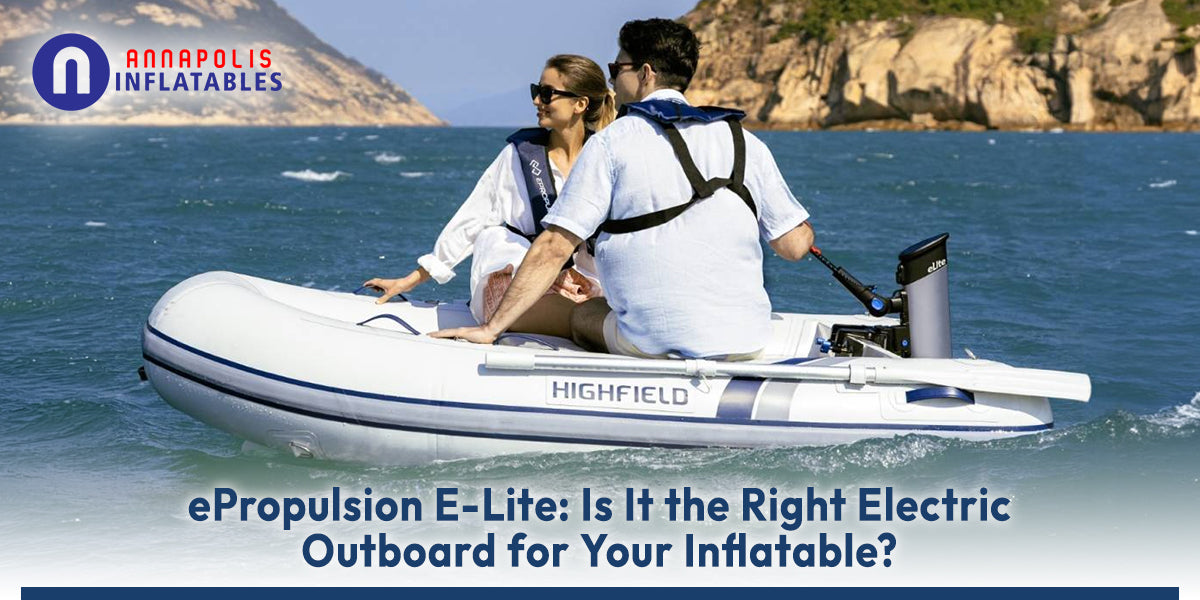
ePropulsion E-Lite: Is It the Right Electric Outboard for Your Inflatable?
Table of Contents:
- ePropulsion E-Lite specifications
- What the ePropulsion E-Lite Does Well
- Where The ePropulsion E-Lite Has Limitations
- Which Inflatables Is The E-Lite Right For?
- ePropulsion E-Lite versus a small gas outboard
- Standard Or Longshaft: Which Variant Do You Need?
- Is the ePropulsion E-Lite Right For Your Inflatable?
- FAQs
The ePropulsion E-Lite is the smallest and lightest motor in the ePropulsion range. At 500W nominal power, 750W in Sport mode, with an integrated 378Wh lithium-ion battery and a total weight of 14.7 lbs excluding the bracket, it is a genuinely compact electric outboard built for small inflatables and tenders.
Whether it is the right motor for your inflatable depends on three things:
- your boat's transom height
- your typical use case
- whether displacement-speed electric propulsion suits how you actually use the water
This guide gives a straight answer to all three, including an honest account of where the E-Lite has real limitations.
ePropulsion E-Lite specifications
The ePropulsion E-Lite is available in two shaft variants, Standard and Longshaft. Both share the same motor, battery, and power output. The difference is shaft length and total motor height, which determines transom height compatibility.
| Specification | Standard | Longshaft |
|---|---|---|
| Nominal Power | 500W | 500W |
| Maximum power (Sport mode) | 750W | 750W |
| Battery | 378Wh 25.2V integrated lithium-ion | 378Wh 25.2V integrated lithium-ion |
| Motor weight (excluding bracket) | 14.7 lbs / 6.7 kg | 16.1 lbs / 7.3 kg |
| Motor weight (including bracket)t | 17.4 lbs / 7.9 kg | 18.7 lbs / 8.5 kg |
| Adjustable shaft length | 11.1" to 15.8" (282.5 to 401 mm) | 17" to 21.7" (432.5 to 551 mm) |
| Transom height compatibility | 11" to 15.7" (28 to 40 cm) | 16.9" to 21.7" (43 to 55 cm) |
| Waterproof rating | IP67 | IP67 |
| Shallow water tilt | 36° | 36° |
| Full tilt (storage/beach) | 75° | 75° |
| Steering angle | ±70° | ±70° |
| Cooling system | Natural water cooling | Natural water cooling |
| Charger included | 220V AC | 220V AC |
| Operating temperature | -5°C to 55°C (23°F to 131°F) | -5°C to 55°C (23°F to 131°F) |
What's in the box:
Every E-Lite ships with the motor, 220V AC charger, clamp bracket assembly, kill switch, propeller, trim pin, and a dedicated outboard bag for transport and storage. The 12V DC charger for charging aboard a boat is an optional accessory not included in the standard package.
What the ePropulsion E-Lite Does Well

Weight and portability
At 14.7 lbs excluding the bracket, the standard E-Lite is competitive on weight with the smallest gas outboards available, a Tohatsu MFS2.5C weighs approximately 13 lbs. The one-click connector allows quick removal and installation without tools, and the included outboard bag makes it genuinely portable as a complete unit. For owners who carry the motor to and from the water rather than leaving it permanently mounted, the E-Lite's portability is a practical advantage that few gas motors at this power level match.
Saltwater and waterproof rating
The E-Lite is rated IP67, fully waterproof to one meter submersion for 30 minutes, and built with marine-grade, high-strength aluminum alloy with protective anti-corrosion coatings. It is fully rated and designed for use in both freshwater and saltwater, including the brackish estuarine conditions of the Chesapeake Bay. Post-outing care requires only a freshwater rinse, the same routine any outboard owner should follow after saltwater use.
Shallow water operation
The clamp bracket tilts to 36 degrees for shallow water operation, keeping the motor running at a higher angle to clear the bottom in tidal shallows and creek mouths. Full tilt to 75 degrees allows beach landings and storage without removing the motor from the transom. For Chesapeake Bay boating in tidal tributaries and shallow anchorages, this operational flexibility is a genuine advantage over motors with fixed or limited tilt.
Zero maintenance cooling
The E-Lite uses natural water cooling, there is no impeller to replace, no cooling system passages to flush, and no overheating risk from running the motor out of the water. This eliminates one of the most common maintenance tasks on conventional outboards and removes the service interval that impeller replacement imposes. For owners who want to minimize maintenance overhead, natural water cooling is a meaningful benefit.
Silent operation and emissions
The E-Lite produces no exhaust and operates at near-silent levels, a practical advantage in no-wake zones, wildlife areas, early morning anchorages, and any environment where noise and fumes are a concern. For yacht tender use in marina environments where engine noise and exhaust at close quarters is an issue, the E-Lite's silent operation is the defining advantage over a comparable gas motor.
USB-C output
The integrated battery doubles as a power bank via USB-C output, phones, tablets, and small electronics can be charged from the motor's battery while on the water. A minor but practical feature for full-day outings.
Where The ePropulsion E-Lite Has Limitations
500W does not plane an inflatable
The most important limitation to understand before purchasing: at 500W nominal power the E-Lite moves a small inflatable at displacement speed. It does not plane. A conventionally powered 6 HP gas motor can bring a small inflatable onto plane; the E-Lite cannot. For owners who need to cover distance quickly, run in chop, or tow a light load, the E-Lite's displacement-speed performance is a hard ceiling. For calm water tender use, marina to shore, yacht to dock, anchorage runs in flat conditions, it is entirely adequate.
Range varies with conditions
The 378Wh integrated battery provides runtime that varies significantly with load, speed setting, water conditions, and wind. ePropulsion does not publish a fixed range figure because the real-world range is genuinely condition-dependent. For short, predictable runs in protected water, this is manageable; you know the distance and can plan accordingly. For open water use where conditions change unexpectedly, range uncertainty is a real consideration. Unlike a gas motor where running out of fuel is resolved by carrying a spare can, a depleted battery requires a return to charge. Plan routes conservatively.
220V AC charging standard: 12V optional
The included charger requires a 220V AC power source, a shore power connection or a land-based outlet. Owners who want to charge aboard a yacht from the vessel's 12V DC system need the optional 12V charger, which is not included in the standard package. Factor this in if your primary charging location is aboard a boat rather than ashore.
Cold weather performance
The E-Lite is rated for operation down to minus 5 degrees Celsius (23 degrees Fahrenheit). For Chesapeake Bay summer and fall use, this is not a concern. For early spring outings in cold conditions or extended late-season use, battery performance degrades in cold temperatures, as it does with all lithium-ion batteries. Expect reduced runtime in cold conditions compared to the rated capacity at standard operating temperature.
Which Inflatables Is The E-Lite Right For?
Transom height is the first filter. Power output is the second. Both must be compatible before the E-Lite is the right choice for a specific boat.
Transom height: standard or longshaft
The Standard E-Lite suits transoms between 11 and 15.7 inches (28 to 40 cm). The Longshaft suits transoms between 16.9 and 21.7 inches (43 to 55 cm). Measure your transom height before ordering, fitting the wrong shaft variant to a transom outside its range creates performance and safety issues. For a full guide to measuring outboard shaft length for an inflatable see our outboard shaft length guide.
Inflatables Boats the E-Lite suits

-
Zodiac Cadet Aero:
lightest Zodiac tender, low transom, designed for calm water and short runs. Standard variant suits the smaller Cadet Aero models for marina and anchorage tender use. Compatible with Torqeedo and conventional electrics including the E-Lite -
Highfield UltraLite:
lightest Highfield series, similar transom profile to the smaller Cadet Aero. Suits calm water, weight-sensitive applications where the E-Lite's 14.7 lb weight is a genuine advantage over a heavier gas motor. -
Small inflatable dinghies for recreational use:
any small inflatable with a transom height within the E-Lite's range, used for calm water recreational use where displacement speed is adequate
Bottom line on compatibility:
The E-Lite is the right electric motor for small, light inflatables used for calm water tender runs and recreational use in protected conditions. It is not the right motor for larger inflatables, higher-load applications, or any use case that requires planning performance.
ePropulsion E-Lite versus a small gas outboard
Most buyers considering the E-Lite are comparing it against a small gas outboard in the 2.5 to 5 HP range. The table below sets out the honest comparison across the factors that matter most.
| Factor | ePropulsion E-Lite | Small gas outboard (2.5 HP) |
|---|---|---|
| Weight | 14.7 lbs (standard, excl. bracket) | ~13 lbs, comparable |
| Power output | 500W nominal / 750W sport | ~1,800W equivalent at 2.5 HP |
| Planing capability | No, displacement speed only | No, displacement speed only |
| Maintenance | Freshwater rinse only | Carburetor, gear oil, spark plugs |
| Running cost | Electricity, very low | Gasoline, higher per hour |
| Noise and emissions | Silent, zero exhaust | Audible, exhaust fumes |
| Range certainty | Half Power 250W – 5.6 Mile / Full Power 500W 3.5 Mile | Predictable, fuel gauge |
| Saltwater rating | IP67, marine-grade aluminum | Standard outboard corrosion resistance |
| Charging | 220V AC (included); 12V optional | Fuel from any gas station |
| Shallow water use | 36° tilt for shallow water operation | Propeller strike risk in shallow water |
The E-Lite wins on maintenance, running cost, noise, emissions, and saltwater protection. A small gas outboard wins on power output, and range certainty. The right choice depends entirely on your use case, for calm-water tender runs in marina and anchorage environments where noise and maintenance matter, the E-Lite is the stronger option. For any use case that requires planning speed or extended range in variable conditions, a larger 6hp to 8hp gas outboard is the more practical tool.
For a full comparison of electric versus gas outboard motors, see our electric vs gas outboard guide.
Standard Or Longshaft: Which Variant Do You Need?
The only difference between the Standard and Longshaft E-Lite is shaft length and total motor height. Power output, battery, and all features are identical across both variants.
- Standard: suits transom heights of 11 to 15.7 inches (28 to 40 cm). Covers most small inflatable dinghies and compact tenders. Four adjustable shaft positions from 11.1 to 15.8 inches provide additional flexibility within the range.
- Longshaft: suits transom heights of 16.9 to 21.7 inches (43 to 55 cm). Covers larger inflatables with deeper transoms. Four adjustable positions from 17 to 21.7 inches.
If your transom height falls between the two variants' ranges, between 15.7 and 16.9 inches, contact Annapolis Inflatables before ordering. Fitting a motor to a transom at the edge of its rated range requires careful verification.
For guidance on measuring your inflatable's transom height correctly, see our outboard shaft length guide.
Is the ePropulsion E-Lite Right For Your Inflatable?
The E-Lite is the right motor if you have a small inflatable, a compact tender or recreational dinghy, used primarily for calm water, short-run applications where silent operation, low maintenance, and zero emissions matter more than top speed or open-water range. For marina tender use, protected anchorage runs, wildlife areas, and noise-sensitive environments, it is a genuinely capable and practical electric outboard.
It is not the right motor if you need planing speed, extended open-water range, or propulsion for a mid-size or larger inflatable under typical load. In those scenarios a gas outboard from the Tohatsu, Yamaha, Suzuki, or Mercury ranges stocked at Annapolis Inflatables is the more appropriate tool.
To request a quote on the ePropulsion E-Lite or discuss whether it suits your specific inflatable, contact the Annapolis Inflatables team at annapolisinflatables.net or call +1 410-267-8681.
Frequently asked questions
How far can the ePropulsion E-Lite travel on a single charge?
Range varies with load, speed setting, water conditions, and wind; ePropulsion does not publish a fixed range figure because real-world runtime is genuinely condition-dependent. For calm water tender use at moderate speed with a light load, the 378Wh battery provides meaningful runtime for short runs. For open water use in variable conditions, plan routes conservatively and factor in the return trip before depleting the battery. If range certainty is a priority for your use case, a gas outboard provides more predictable range through a fuel gauge.
Can the ePropulsion E-Lite be charged from a 12V boat battery?
Yes, but the 12V DC charger is an optional accessory not included in the standard package. The included charger requires a 220V AC power source. If you plan to charge the E-Lite aboard a yacht or boat from a 12V system, confirm you have the optional 12V charger before your first outing.
Is the ePropulsion E-Lite suitable for saltwater use?
Yes, the E-Lite is fully rated for saltwater use. It carries an IP67 waterproof rating, is built with marine-grade aluminum alloy, and has protective anti-corrosion coatings on all exposed components. Post-outing care requires a freshwater rinse, the same routine recommended for any outboard motor used in saltwater or brackish water conditions.
What is the difference between the Standard and Longshaft E-Lite?
Shaft length and total motor height only, power output, battery capacity, and all features are identical across both variants. The Standard suits transoms of 11 to 15.7 inches (28 to 40 cm); the Longshaft suits transoms of 16.9 to 21.7 inches (43 to 55 cm). Measure your transom height before ordering to confirm which variant is correct for your inflatable.


 Powered by goodChatBot